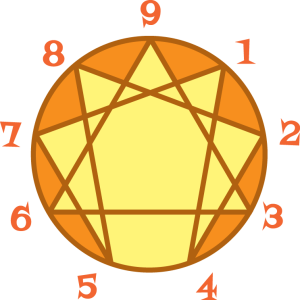
Don, Don, He’s a 1!

Don and I have been critiquing each other’s writing for about five years. Shortly after we met, he completed an Enneagram test that figured him to be a 9. I didn’t know him very well then, so a 9 he was. Although every once in a while I wondered about that, we never talked about the Enneagram until I decided to start this blog, at which time he completed my Stance Keyword Comparison Checklist. The results indicated he was a Compliant type, and we soon determined he’s a 1w9—a profile that fits him much better and explains quite a lot.

So, in one corner of the critique ring, wearing the white trunks, we have:

Do It the Right Way (Don)

and over in the other corner, wearing the black trunks:

Do It My Way (me)

Thank goodness for the moderating influence of our wings, his 9 and my 7. Sure, we’ve had a couple of minor skirmishes. One time when we were meeting as part of a critique group in a bookstore café, I took the lid off my cup of coffee, and the person to my right backed away from the table, assuming I intended to toss the contents at Don. But no knockout punches have been delivered to date and no liquid refreshments have been tossed. Continue reading

Bob Marley: a Messianic State of Mind

Last weekend, I met some friends at the Guild Theater to see the new documentary, Marley, by Kevin Macdonald. When I got home afterward, I loaded up the CD player with Exodus, Babylon by Bus, Catch a Fire (both discs), and Confrontation. That left five more CDs for round two. Yeah, I’m a Bob Marley fan. I’ve read Catch a Fire, the Life of Bob Marley, by Timothy White a couple of times and have watched Time Will Tell, the documentary on the DVD, Legend, multiple times, too.

It’s kind of hard to see through the curtain of smoke produced by all the ganja Robert Nesta Marley smoked to what might have been his core personality, and I’m not generally in favor of typing public figures, but I’m going to take a stab at it in this case. I think Marley was a straight-up 8—no wing.

In addition to growing up in extreme poverty and violence in Trenchtown (next to Kingston, the capital of Jamaica), he was viewed as an outcast because his mother was black and his father—who he was named after, but who didn’t stick around—was white. As a youth, he was a bit of a brawler. One of his nicknames was Tuff Gong, which became the name of his record label. From Catch a Fire: Continue reading

The Path of Most Resistance

In the TV series Star Trek: Voyager, the Borg told everyone they encountered that resistance was futile. Before that, Carl Jung said, “What we resist persists.” But no matter who said it or when, we resist accepting the limits of our resistance.

All we want to do is travel unobstructed along our particular garden path. So just as we move through life scanning the environment for what helps reinforce our self-concept and screening out what threatens it, we also put a great deal of effort into resisting what gets in the way on our particular path. Not only is such resistance futile, it also uses up an incredible amount of energy.

Scanning, screening out, and resisting are the triumvirate of activities that keep us assembling the world in a particular way. The more successful we are at them, the more comfortable we become in our well-worn ruts to the point where we can’t see or imagine any other way to be or think or feel. It’s like a narrowing of the arteries of the psyche. Yet all these behaviors seem so natural we may not even be aware we’re making choices or doing anything.

The other problem, of course, is that no matter how much we resist something, our resistance won’t make it go away. A great deal of what we resist persists simply because it’s an unalterable part of life. What we resist exists. Acceptance might be a more appropriate response. But whatever we resist may be so important to us that we go to enormous lengths to avoid confronting or dealing with it. That’s the biggest difference between what we simply screen out (ignore) and what we resist (actively work at avoiding).

  • Type 1s are aiming for perfection—and if not that, at least correctness. They want to be irreproachable, at least in their own eyes. Therefore, they resist criticism from the environment. Continue reading

A 6 Notices . . . Everything!

In The View from Here, I wrote that, as a result of their constant vigilance, 6s don’t do as much screening out as the other types do. The following piece is a journal writing exercise completed by a Type 6 for a group I facilitated. The subject was self-observation, and she chose “notice” as her prompt for flow-writing.

Noticing What I Notice

I can’t help but notice things. That’s just what I do. I don’t deliberately notice this, but ignore that. I just notice things—everything. I see patterns. I see behaviors. I notice all the stupid inconsequential things in life, it seems. Although I know that some of the things I notice truly don’t matter, I notice them anyway. It’s more than just noticing, however. I notice something, then I study it, label it, and file it away in its appropriate folder, so that when I need it, I can readily find it.

So what is all this noticing about? I surely don’t lavish the same amount of attention on noticing what I’m doing—it’s only others. So I notice everything others are doing, but not myself. Well, isn’t that about the most useless piece of time wasting there is? Why will I notice you, but not me? What don’t I want to see in myself? Do I see that I am the same, or do I not see my flaws? Can’t face my flaws? Or maybe I don’t have the flaws that I am noticing? Maybe I think I notice everything, but really I just notice what I want to notice. Because I also know that there is a whole lot that I don’t notice, that I don’t see, that I am willing to ignore—things that go right by me.

What is all this attention to things that usually don’t matter really about? I guess it’s that focusing on others rather than on myself is a whole lot easier. The next time I catch myself noticing what someone else is doing, I am going to recall this writing, and at that moment, I will remember to remind myself that this probably does not need to be filed away. This will be a gentle reminder to myself that I am being too busy noticing others, and it’s time to turn my attention inward.

This diffused attention can create a fair amount of mental clutter, which the writer alludes to. 6s are extremely attentive to reactions from other people and threats or even just changes in their environments, which makes it difficult for them to turn their attention inward. Even their defense mechanism—projection—is aimed out there!

But when they can relax (crazy concept, I know) and soften their attention to the outer world, they can then tune in to their inner world—to themselves—with some compassion, acceptance, and humor.

~ ~ ~

Things have been going so well that he’s taking an anxiety break to keep centered.

StoryPeople

Fuzzy Focus: a 4 “lets ‘er rip”

Type 4s are strange birds to many of the rest of us, and of course they are secretly, if not outright, proud to be seen as such. After all, who would want to be just like everyone else? In my last post, I mentioned that 4s scan the environment for raw material, and that material can be tangible or intangible. Here’s an example of how this scanning affects 4s’ ability to focus—or not. My partner, who was a 4w5, wrote this piece for one of my newsletters about 10 years ago. I’m operating on the assumption he won’t object to my posting it here now. In any case, he can’t.

A Four Looks at Focus
R.C. Jones

A rather drab auditorium in the public school mode. I grip the edges of the podium and clear my throat.

“Thank you for asking me here” … I peer nervously into the wings to my left and right … “to discuss ‘focus.’” I glance at my notes: a single bond sheet bearing unconnected words scrawled at arbitrary angles, which, while possibly from the same pen, are as various in style as a Saul Steinberg. Is his work, particularly the later pieces, drawing or cartooning? The editors are in on it, one would think; they present him almost solemnly—a double-truck in The New Yorker. Geez! There I go with the print media jargon, after lo, these many years. So, a cliché, already. I enjoy a well-worn cliché (itself a cliché, that.).

Got to regain my focus, I suppose. After all, what’s the point? A water glass has been thoughtfully or, for all I know, automatically provided by the lecture committee. Or the lecher committee (if they only knew me!). I’m here about … water. That’s it! Last moment consideration: left over from previous speaker? No lip prints. I sip with caution.

Humans are about ninety-seven percent water, unless I made that last fact up. I do sometimes, which is okay with me except that sometimes I forget I did so. I’m already keeping track of a “gazillion” factoids. (I’m running an inquiry as to the origin of “gazillion”—suspect it’s commercially fabricated teen-speak. Not like “googol,” which is a real word for a real number: one followed by one hundred zeros. It was supplied by a mathematician’s eight-year-old kid.) If humans are mostly water, why do they carry plastic liter jugs of the stuff and hit on them while they’re driving, whenever they can tear themselves away from their cell phones? If they intake that last three percent, will they morph into slurpy, silvery water creatures like in “The Abyss”?

I always have trouble with these two film titles. “The Abyss” is the underwater rat in real time, and “The Deep” is Jacqueline Bisset in a wet tee-shirt. No rat. Continue reading

The View from Here: Habits of Attention

Habits, Part 5

If you’re not a bird watcher but go for a walk in the woods with someone who is, you’ll probably be surprised at how many birds your companion notices that you don’t see until she points them out to you. And even then you might not see all of them. While you’re enjoying the warmth of the sun, the myriad of wildflowers, the physical exertion of walking, or maybe the general ambiance of being on the trail, your companion is screening a lot of that out in order to focus her attention on birds. Essentially, she’s scanning the environment for birds. And no matter where she is, she’ll likely notice more birds than the other people around her will.

In one way or another, each of us is traveling our respective path or trail scanning for birds. We’re just not all scanning for the same species of bird. And in order to pick out, say, all the red-winged blackbirds, we have to screen other things out—like the rustling of the wind in the trees, the squirrels scurrying about, and all those other irrelevant birds.

Each Enneagram type has different priorities and biases, and those priorities and biases determine what we’re aware of (screen or scan for) and what we’re not aware of (screen out). In other words, we habitually notice some things and habitually try to push other things out of our conscious awareness. Some people claim we create our own reality, as if there is no objective reality whatsoever. It’s a gross oversimplification. But we do each experience reality differently by virtue of our habits of attention.

  • Type 1s scan the environment for chaos or disorder to right (in themselves or others). They screen out anything they perceive of as frivolous or purposeless.

I once worked with a Type 1 who kept a supremely neat desk. Another co-worker liked to tweak him occasionally by waiting until he left for the day and then moving one object a few inches to the left or right. The next day, the first thing the 1 would do was return the object to its “correct” location. Continue reading

You’ve Got to Believe

Habits, Part 4

It may seem too obvious to have to say it, but in addition to identifying all the components of a particular habit loop, there’s one more vital element to changing it: the belief that you can do it. In the case of a years- or decades-long habit you’ve tried and failed to change or do away with numerous times, the belief that you have any control over it may have faded long ago. Resignation has likely set in. So it’s probably best to not pick one of those habits to experiment with changing.

The belief that I couldn’t exercise in the morning because I’m not a morning person was bolstered time and time again by my failed attempts to do so. I tried exercising with different tapes, DVDs, or TV programs. I experimented with different kinds of exercise. I signed up for many a gym membership. The closest I ever came to regular exercise in the morning was walking to work when I had to. But the interesting thing about my current morning exercise routine is that it didn’t take hold as a result of any intention on my part—or any change in my belief that I could exercise in the morning. However, I had already changed another long-standing habit I previously believed was set in concrete—which is the time I get up in the morning. Because I don’t have to be anywhere at any particular time in the morning, I don’t have any external motivation not to stay up late and then get up late. Even so, getting up late often made me feel like I was behind before my day had begun. So over a period of several months, I successfully managed to change both my bedtime and my waking time.

Getting out of bed an hour and a half to two hours earlier than I used to turned out to have several rewards. The first was a feeling of accomplishment. The second was having more time in the morning. And the third—much more subtle, but possibly the most valuable of all—was a change in my belief about how not-being-a-morning-person doomed me in certain ways. When I look back at the beginning stages of my exercise habit loop, I see how having more time provided me with the opening to start taking morning walks. It was kind of a novelty at first, since I sometimes found myself out walking around when I would normally have been rolling out of bed. But I don’t think that habit loop would have developed so quickly without the change in my belief.

When it comes to the mechanics of changing an existing habit, Charles Duhigg says there isn’t one specific formula because one habit is different from another. And, as we know all too well, people are different from each other, too. But Duhigg offers an overall framework for changing habits:

  • Identify the routine
  • Experiment with rewards
  • Isolate the cue
  • Have a plan

On his website, there’s a link to A Reader’s Guide to Using These Ideas, the Appendix from his book, The Power of Habit. It has some good suggestions and a lot more detail about the steps of his framework for changing habits. You can read it online or print a pdf copy.

Once you understand how a habit operates—once you diagnose the cue, the routine and the reward—you gain power over it.

– Charles Duhigg

Cultivating a Craving

Habits, Part 3

I had the flu last month for the first time since the early ‘80s. One of the most annoying side effects was the crimp it put in my exercise routine. I delayed going back to the fitness room until I’d built up my stamina by walking around the neighborhood. I determined ahead of time exactly which day I was going to get back on the treadmill. When that day arrived, I went through my usual morning routine, including five minutes of stretching. But I had more work to do than usual that day and getting some of it done before exercising seemed like a good idea. I told myself that even if I didn’t go to the fitness room, I could always take a walk later. But it wasn’t so easy to derail my exercise habit. Not only did my brain pick up on the cue for that routine, it was actually anticipating the reward—energy and a sense of well-being. In fact, my brain was craving the reward.

This explains why habits are so powerful: They create neurological cravings. Most of the time, these cravings emerge so gradually that we’re not really aware they exist, so we’re often blind to their influence. But as we associate cues with certain rewards, a subconscious craving emerges in our brains that starts the habit loop spinning.

– Charles Duhigg

Duhigg says that a cue and a reward are not enough to create a long-lasting habit. The cue has to trigger a craving as well as the routine. In order to change a habit, we need to identify the cue and the reward and then replace the old routine with a new one. But the new routine has to satisfy the craving for that particular reward or it won’t work.

One of the problems with automatic behavior is that we’re likely not aware of what’s going on in the brain when we’re doing it, so it isn’t easy for us to tease apart the elements of a particular habit loop. This is the same issue we face when trying to become aware of our type-based automatic responses in life. In both cases, we need to try to make conscious something about which we’re unconscious. We need to become more aware. We need to develop our self-observation skills.

There are lots of ways to develop self-observation skills, including meditation and journal writing. But the idea of identifying and focusing on one “chunk” of automatic behavior—one habit—at a time is appealing to me. It’s very do-able, for one thing. And success in inserting one new routine into an existing habit loop can lead to success in inserting other new routines into other existing habit loops. Each time we do it, we become a little more aware of the unconscious underpinnings of our behavior. Yes, we’re still handing off “chunks” of behavior to the basal ganglia, but we are the ones choosing those routines. The process is not occurring outside our control.

Habits never really disappear, Duhigg says. They’re encoded into the structures of our brain. So we can be at the effect of our existing habits, most of which were created without our conscious intent, or we can learn how to modify them in ways that better serve us.

Your Basal Ganglia & You

Habits, Part 2

In The Power of Habit, Charles Duhigg mentions a paper published in 2006 by a Duke University researcher claiming more than 40 percent of the actions people perform each day are habits rather than decisions—meaning the actions are unconscious rather than conscious. This isn’t surprising to anyone familiar with the Enneagram, the premise of which is that we are all essentially sleepwalking through life, each according to the dictates of our particular type. But I was surprised to learn the habit habit is actually a labor-saving device created by our brains.

Neuroscientists have found that when a new behavior is being learned, the frontal cortex of the brain is extremely active. But after enough repetitions of a routine, activity in the frontal cortex decreases and the basal ganglia takes over. The basal ganglia, according to Duhigg, is “a golf-ball sized lump of tissue” located deep in the brain where the brain stem meets the spinal column. (The brain stem and spinal column are more primitive parts of the brain than the frontal cortex. They control the automatic behaviors that keep us alive, such as breathing, heartbeat, blood pressure, etc.)

When a habit emerges, the brain stops fully participating in decision making. It stops working so hard, or diverts focus to other tasks.

– Charles Duhigg

Frontal cortex activity uses up a lot of energy. So in an effort to be more efficient, the brain attempts to turn routines into habits, thus allowing our minds to “ramp down.” We don’t have to waste energy thinking about how to get to work, or ride a bicycle, or toast a piece of bread in the morning. That frees up the frontal cortex to do other things, such as solve problems, invent widgets, write symphonies, or find some trouble for us to get into. The basal ganglia is so good at this process it can store habits even when the rest of the brain is asleep. That’s why my brain was able to take my five minutes of stretching and make it a cue for me to begin my exercise routine even though I wasn’t at all aware of the connection.

Brain efficiency is all well and good, but if the brain were to ramp or power down at the wrong time, we might fail to notice something of vital importance to our survival. That’s where the habit loop comes in. The sequence of actions that includes the cue, the routine, and the reward is known as “chunking.” The brain ramps down and turns things over to the basal ganglia when a recognizable “chunk” of behavior starts, and then it ramps back up when the chunk of behavior ends.

So running on autopilot is just part of the human condition. We can’t really prevent the brain from doing its thing and it wouldn’t even be a good idea to try. But once we grasp how the habit loop works, we do have some control over which of our behaviors get “chunked.”

Hat-Railings & Other Habits

The Power of Habit

Sometime in the 1890s, William James wrote The Laws of Habit. He could easily have been talking about the Enneagram:

Ninety-nine hundredths or, possibly, nine hundred and ninety-nine thousandths of our activity is purely automatic and habitual, from our rising in the morning to our lying down each night. Our dressing and undressing, our eating and drinking, our greetings and partings, our hat-railings and giving way for ladies to precede, nay, even most of the forms of our common speech, are things of a type so fixed by repetition as almost to be classed as reflex actions. To each sort of impression we have an automatic, ready-made response.

Not too long ago, I caught the end of an interview on NPR with Charles Duhigg, author of The Power of Habit. He was summarizing what scientists refer to as the habit loop, a three-part process that consists of a cue, a routine, and a reward.

Throughout my life, I’ve made countless failed attempts to develop a morning exercise routine. I’ve never had any trouble exercising in the afternoon–or even fairly late in the evening (it never kept me from sleeping). But, no matter how hard and how many times I tried to exercise in the morning, I’ve never been able to do it. Until now, anyway. All of a sudden, and without any pain or resistance, I seem to have developed a morning exercise routine. In fact, I now prefer doing it at that time of day. I thought maybe I could look through the lens of the habit loop to try to understand what’s going on. Continue reading