Category Archives: Enneagram

Keywords: The Madeleines of Journal Writing

Before starting this post, I went into the closet in my office in search of three plastic sandwich bags full of folded slips of different colored paper with words typed on them. I’ve used those bags (and words) in my own creative writing exercises as well as in writing workshops. I found one bag full of lime green nouns, one bag full of fuchsia verbs, and one bag full of teal adjectives. I opened the teal bag without recalling what kind of words were inside and pulled out new. New is good—and so apt for the beginning of a post!

I’ve been playing around with individual words and phrases for decades. My Stance Keyword Comparison Checklist was an outgrowth of a long-term fascination with arranging and grouping words that seem to evoke a concept or a mood or an attitude or a way of being. Sometimes it’s easier to gauge your reaction to a list of keywords than it is to read through narrative descriptions. A single word can send you off on a journey, much like the madeleine that sent Marcel Proust off in Remembrance of Things Past.

When I was a substance abuse counselor, I used a two-page handout called “How Do You Feel Today?” It consisted of 140 words that described feeling states, each one illustrated by what was essentially an emoticon (although I’m pretty sure the handout pre-dated emoticons). It wasn’t in color, but it looked a little like this example (without the misspelling). Continue reading

An Idling Mind

Most of the time, without realizing it, we leave the mind idling on the street with the key still in the ignition, where it wastes gas and pollutes the air until some vagrant thought drives off with it.

Eknath Easwaran
Spiritual Teacher

Blue Mountain Center of Meditation

You Can Call Me (Antisocial) Al

Al was one of my clients when I worked as a substance abuse counselor at the methadone clinic. Somehow I managed to persuade every single one of my clients to complete an Enneagram questionnaire, so I knew he was a Type 5. With his shaved head (usually covered by a baseball cap) and multiple tattoos, Al was a little off-putting, appearance-wise. He had spent more than one stint in San Quentin where he joined an Aryan Brotherhood gang. As he—and several other ex-con clients—explained to me, you had to belong to some group in prison in order to survive. He never seemed very committed to the white supremacist thing, and being a 5, he certainly wasn’t part of any gang on the outside.

Somewhere along the way, Al had encountered a psychiatrist who diagnosed him as having Antisocial Personality Disorder. I’m not sure what the psychiatrist was thinking. Did he believe that because Al had committed antisocial acts, he must therefore have Antisocial Personality Disorder? I don’t know. And I wouldn’t have cared, except the doctor was so convincing Al took on the diagnosis as part of his identity. It was as if he introduced himself by offering his hand and saying, “Hi, I’m Al. I have Antisocial Personality Disorder.”

Meow!

The disconnect for me was that Al was unfailingly prompt for his counseling appointments and far more considerate of me than many of my less-sinister-appearing clients. He’d knock softly on my door and stick his head into my office after the client ahead of him had left. “I just wanted you to know I’m here,” he’d say. “Take your time. If you need a break, I’ll wait.” Continue reading

Subliminal Persuasion?

We’re all exposed to a massive number of suggestions and influences from the environment every day. Yet we don’t all respond to them, and we don’t all react to them the same way. I may be influenced by something you don’t even register and vice versa. It’s obvious we aren’t merely passive receptors for whatever is going on around us. This is a subject that has fascinated me from early childhood and is one of the reasons I’m predisposed to be interested in things like the Enneagram, the MBTI, and various areas of psychology and neuroscience.

The May/June 2012 issue of Scientific American Mind includes an article titled, “The Subtle Power of Hidden Messages,” which isn’t about personality or temperament, per se, but still speaks to the issue of who responds to what stimuli—and when. The author’s conclusion was that, yes, subliminal messages or advertisements can influence our behavior. But they can’t actually cause us to do something we wouldn’t ordinarily do. They can’t brainwash us. They can’t redirect our will. We’re only susceptible to subliminal messages in certain limited situations: when we’re open to persuasion because of a particular need—i.e., we’re looking for something, whether or not we’re consciously aware of looking for it.

Thirst is an example of one such need we might not be consciously aware of or conscious of trying to fill. Continue reading

Balancing Act in Two Parts

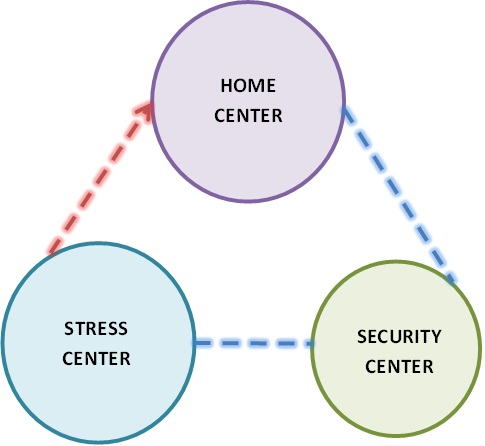
The three Centers of Intelligence of the Enneagram have often been described as a three-legged stool. To keep the stool level and upright, all three legs need to be in balance. Our tendency is to be out of balance, each according to our compulsions and fixations. Most of our attention goes to the drives of our Home center/point. It’s the Stress point and Stress center that play a pivotal role in reining in those compulsions and bringing our core personality into balance.

The two kinds of types, Exterior and Interior, access their Stress centers differently. [See the Center Relationships chart for details on each type.]

 EXTERIOR TYPES

When Exterior types (the six types connected by the lines of the hexad, 1, 2, 4, 5, 7, and 8) are functioning on autopilot, their Stress center supports and fuels their compulsions.

 Energy flows ONE-WAY.
The Stress Center drives the Home Center.
The Security Center is least effectively accessed.

Continue reading

Patterns of Motion

All types are not created equal—at least in terms of how they relate to the three Centers of Intelligence and, therefore, how they are out of balance. The way we move around our triad can be described as a particular pattern of motion. Some of the types have one pattern of motion and some of the types have a different pattern of motion.

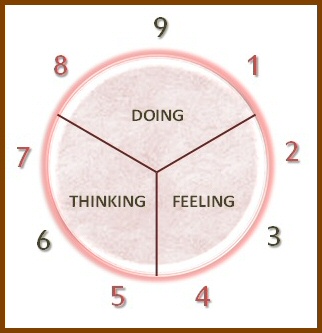
I call the types connected by the lines of the hexad (1, 2, 4, 5, 7, and 8) Exterior types because they’re located at either end (the exterior) of their respective centers:

8 and 1 in the Doing center
2 and 4 in the Feeling center
5 and 7 in the Thinking center

I refer to the types connected by the lines of the triangle (3, 6, and 9) as Interior types because they’re located in the middle (interior) of their respective centers.

Exterior Types

Exterior types are pretty straightforward. A Type 2, for example, could have a 1 wing or a 3 wing (meaning it could be strongly influenced by one of the types on either side). Or it could be a straight-up 2 with no wing. And as is true with all types, a 2 can be high-functioning, low-functioning, or somewhere in between. What is true for all Exterior types—but not true for Interior types—is that each Exterior type always has the same stress point and the same security point. All 2s, for example have 8 as their stress point and 5 as their security point. Continue reading

Three Types in One!

The circle of the Enneagram symbol contains two linear figures, the triangle linking points 369 and the hexad linking points 142857. (See the diagram to the right.)

The direction of the lines of the hexad pertains to what is known as the process Enneagram. Although I’ve been aware of the process Enneagram for years, I haven’t studied it, so I’m not a reliable source for defining it or explaining how it works. [Both John G. Bennett and Anthony G.E. Blake have written about the process Enneagram.]

In the psychological Enneagram, the three Centers of Intelligence organize the nine types into groups of three: Doing (8, 9, 1), Feeling (2, 3, 4), and Thinking (5, 6, 7). And within the psychological Enneagram, there are three triads—three equal triangles—each with a “foot” in one of the centers:

3 (Feeling) / 6 (Thinking) / 9 (Doing)
2 (Feeling) / 5 (Thinking) / 8 (Doing)
1 (Doing) / 4 (Feeling) / 7 (Thinking)

Continue reading

Type 4 Mom on a Bad Day

Another in the series of Type comics. See Type 7 here.

Squaring Off with the MBTI

Many years ago, before I’d heard of this thing called the Enneagram, I took a job as an office manager where I had to share an office with the company accountant. He was a consultant and had several other clients, so he wasn’t there all the time. Besides, it was quite a large space with exterior windows on one wall and lots of glass on another. Our desks were across the room, in opposite corners, about as far away from each other as they could be.

He seemed an affable sort of guy at first glance. I probably seemed pleasant enough to him, too. But within a month, it became obvious we saw eye-to-eye on almost nothing. The situation became so disagreeable that he tried (and failed) to get me fired, and I threatened to bring a roll of duct tape into the office and run it from one corner to the other to mark off our respective halves of the room.

Then I had another thought. Continue reading

Ennea-Journaling the Compliant Stance

Thank goodness for the Compliant types! They may have a tough row to hoe trying to cajole the Aggressive and the Withdrawing types into getting with the program—which must be a lot like herding cats—but at least they’re aware there’s a program everyone needs to get with. If the rest of us would just cooperate a little more, it would take a lot of the pressure off them, and they’d be able to loosen the reins on their hypervigilance.

It’s hard to face that open space.

— Neil Young

Is this your stance or the stance of someone you know? Compliant types often present a calm, capable, pleasant persona to the rest of the world, while inside they may be filled with anxiety and apprehension. In spite of their inner turmoil, they tend to be loyal and responsible individuals who do what they say they will do—personally and professionally.

Here are some topics to use for journal writing with a focus on the Compliant stance. If this isn’t your stance, but is the stance of someone close to you, try writing one of the following exercises from that person’s perspective. For flow-writing, set a timer, write a topic sentence at the top of a page, and then begin writing. Keep your pen moving across the page, even if you can’t think of what to write next. Write “blah, blah, blah,” if you have to. Trust that you’ll get back into the flow. Continue reading