With her invisible Type 5 husband. Fourth in a series of Type comics. See also: Type 7, Type 4, and Type 9.


My previous two posts summarized the three Doing center types and the three Feeling center types and suggested traveling songs for each of those six types. To complete the road song set, let’s review the three Thinking center types. People who rely primarily on this center don’t necessarily have higher IQs than those who rely on the other centers. They just trust their mental faculties—their ability to reason—more than they trust their feelings or their gut instincts.
This humorous (or not) excerpt from The Developing Mind by Daniel J. Siegel shows the difference between emotional intelligence and cognitive intelligence:
A frustrated wife looked at her confused husband and said, “You never understand what I am talking about. All you know is what you have learned in books. You couldn’t read my face if your life depended on it!” To this challenge, the man responded, “I can tell from what you say that you’re probably not happy with me. But, you know, there are two kinds of people in this world: those who are too needy, and those who aren’t.”
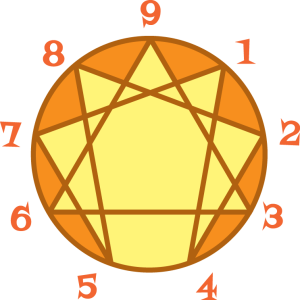
The Thinking center—also referred to as the Head, Intellectual, or Mental center—consists of Types 5, 7, and 6. This center is concerned with personal power, self-definition, logic, rationality, planning, intelligence, and will. Continue reading
Posted in Enneagram, Road Songs, Thinking Center, Type 5, Type 6, Type 7
Tagged Enneagram, Thinking Center, Type 5, Type 6, Type 7
Al was one of my clients when I worked as a substance abuse counselor at the methadone clinic. Somehow I managed to persuade every single one of my clients to complete an Enneagram questionnaire, so I knew he was a Type 5. With his shaved head (usually covered by a baseball cap) and multiple tattoos, Al was a little off-putting, appearance-wise. He had spent more than one stint in San Quentin where he joined an Aryan Brotherhood gang. As he—and several other ex-con clients—explained to me, you had to belong to some group in prison in order to survive. He never seemed very committed to the white supremacist thing, and being a 5, he certainly wasn’t part of any gang on the outside.
Somewhere along the way, Al had encountered a psychiatrist who diagnosed him as having Antisocial Personality Disorder. I’m not sure what the psychiatrist was thinking. Did he believe that because Al had committed antisocial acts, he must therefore have Antisocial Personality Disorder? I don’t know. And I wouldn’t have cared, except the doctor was so convincing Al took on the diagnosis as part of his identity. It was as if he introduced himself by offering his hand and saying, “Hi, I’m Al. I have Antisocial Personality Disorder.”
The disconnect for me was that Al was unfailingly prompt for his counseling appointments and far more considerate of me than many of my less-sinister-appearing clients. He’d knock softly on my door and stick his head into my office after the client ahead of him had left. “I just wanted you to know I’m here,” he’d say. “Take your time. If you need a break, I’ll wait.” Continue reading


 Nine Paths