Category Archives: Type 7

Tales of a 6: Tangled up in Not Knowing

After coming to terms with being a 6w7, rather than a 7w6, my friend Debbie has been looking at how type plays out in her life. The enthusiasm of her 7 wing really comes through when she talks about getting hooked on things that interest and excite her. She was also quite candid about some of the challenges of being a 6, for which I’m very grateful.

This is part of a continuing conversation. Click here for Part 1.

D:     If something sounds interesting to me, I don’t care how busy I am, I figure I can do this. And I do.

J:       And being able to accomplish things and get the feedback from doing that is important.

D:     True, because for the most part, when you accomplish something, it’s really highly positive feedback. But what I’ve come to realize is that even though I was getting positive feedback, it was based on what other people wanted from me and not really what I saw as personally meaningful. It was always what someone else thought was important.

J:       What’s different now?

D:     Now I’m trying to explore the things that would be more meaningful for me so I can be more selective about what I say yes to. Is this particular project something I would like to do? Sure, some of the importance of the project comes from outside, but maybe it’s also something I want to do. I also want to find things to do that are important to me—regardless of anyone else—and find the time to do them. I don’t want to just fill my time with other people’s projects and to-do lists.

J:       You don’t want to only do things for other people’s approval or acknowledgement.

D:     Right. Sometimes my own approval and acknowledgement are enough. Continue reading
A Curious Case of Mistyping

My friend Debbie, whom I’ve known for close to 40 years, spent a few weeks with me this summer, and I took the opportunity to tape record a discussion with her about her experience with the Enneagram. When she first tried to determine her type, she settled on 7w6, and since that seemed a reasonably good fit, neither of us questioned it. That is, until last summer. Towards the end of her visit last year, several things about what she was doing and saying jumped out at me as being at odds with type 7.

Being mistyped is not at all uncommon. There are lots of reasons for it. But it happens to some types more frequently than to others.

I’ve broken my conversation with Debbie into five parts. Here is part one.

J:       What was interesting to you about the Enneagram?

D:     It seemed like if there was a way to understand better what was going on with me, what was driving things—the way I was looking at things—that would be a good thing to do. I hadn’t yet done the Myers-Briggs or anything like that, but I was interested in psychological kinds of things and what made people tick. I was interested in finding out what made me tick.

J:       So it was primarily to get some personal insight. What did you find out?

D:     Well, I thought I found out that I’m a 7 and that explained quite a bit about me. I was always interested in a lot of things and willing to kind of go down whatever path struck my fancy at the moment. I’m interested in this, and I’m interested in this, and I’m interested in this. It really fit. I’m a 7. It’s pretty cool. That gave me a sense of it being OK to have a lot of interests and to not know which one I wanted to nail down.

J:       It validated some of your own experience.

D:    Yes, and it gave me an explanation for it, so that if I looked at someone who seemed to have an idea of exactly what they wanted to be doing and didn’t have all of this other stuff going on, I thought, well, they must not be a 7. So, yes, it made me understand myself better. Continue reading

Songs for the Road: Thinking Center

My previous two posts summarized the three Doing center types and the three Feeling center types and suggested traveling songs for each of those six types. To complete the road song set, let’s review the three Thinking center types. People who rely primarily on this center don’t necessarily have higher IQs than those who rely on the other centers. They just trust their mental faculties—their ability to reason—more than they trust their feelings or their gut instincts.

This humorous (or not) excerpt from The Developing Mind by Daniel J. Siegel shows the difference between emotional intelligence and cognitive intelligence:

A frustrated wife looked at her confused husband and said, “You never understand what I am talking about. All you know is what you have learned in books. You couldn’t read my face if your life depended on it!” To this challenge, the man responded, “I can tell from what you say that you’re probably not happy with me. But, you know, there are two kinds of people in this world: those who are too needy, and those who aren’t.”

The Thinking center—also referred to as the Head, Intellectual, or Mental center—consists of Types 5, 7, and 6. This center is concerned with personal power, self-definition, logic, rationality, planning, intelligence, and will. Continue reading

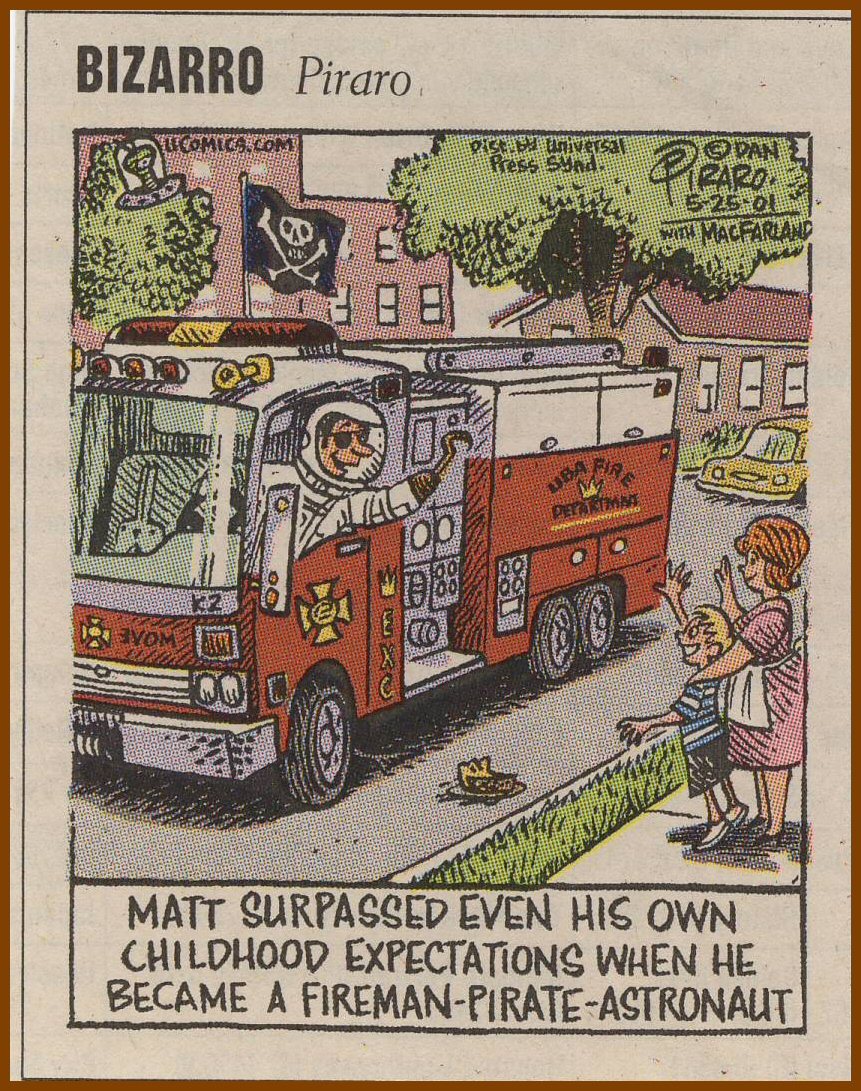
Type 7 Career Guy

Sometimes a comic (strip or single panel) really nails it. I guess that’s why they’re still around. I’ve found at least one for each type, so if this isn’t you, just wait. Yours is coming.