Category Archives: Enneagram

Deciphering the Ink Blots

What was once called the objective world is a sort of Rorschach ink blot, into which each culture, each system of science and religion, each type of personality, reads a meaning only remotely derived from the shape and color of the blot itself.

Lewis Mumford, scholar and writer, 1895-1990

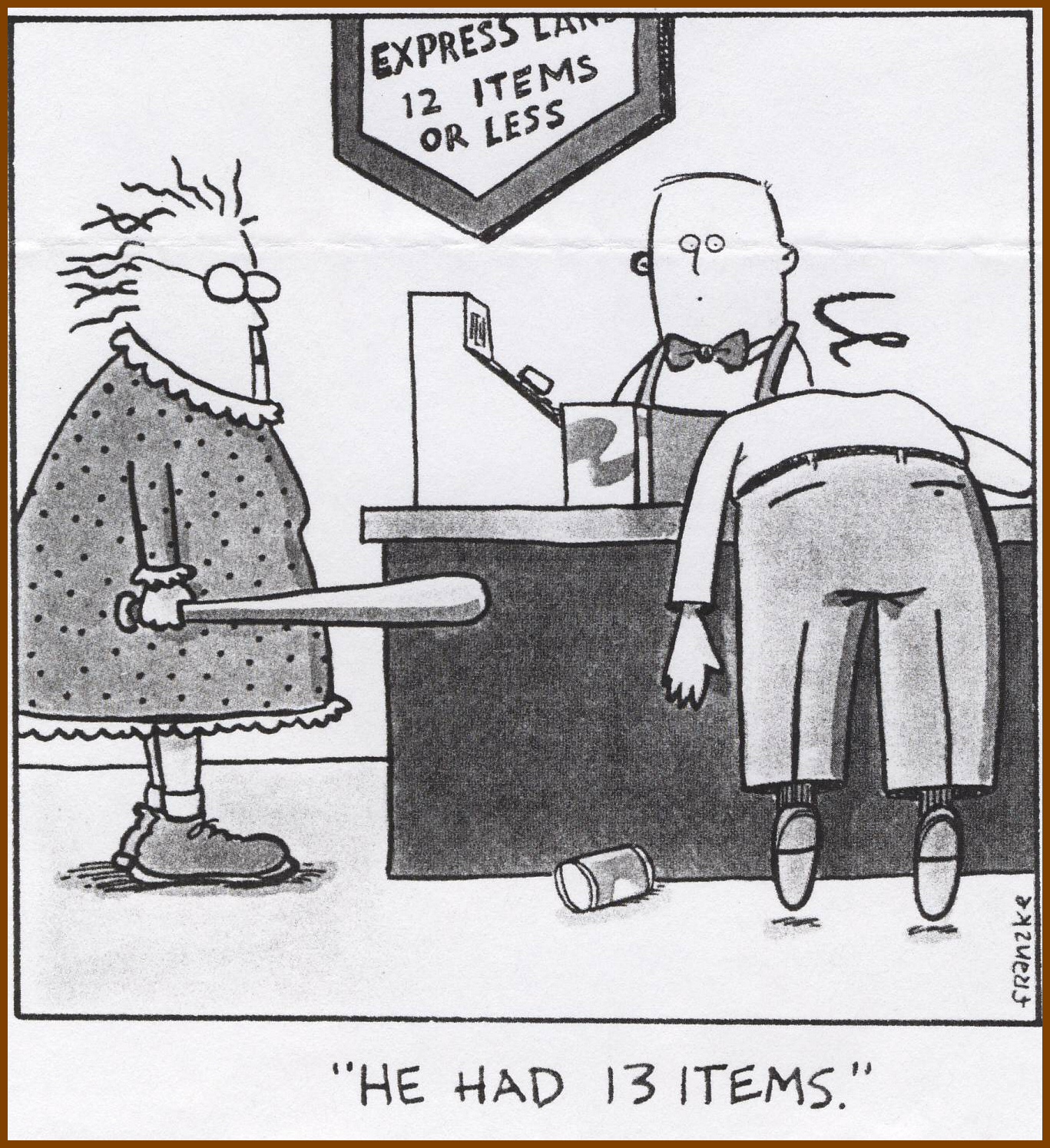
Type 1 Shopper

The latest in a series of Type comics. Also see Type 7, Type 4, Type 9, and Type 2.

Psychic Entropy: What Gets in the Way?

Sometimes a temper tantrum is the most appropriate response to upsetting people, events, or situations. Or maybe it’s the only response we’re capable of when we’re overloaded with stress, which Webster’s Ninth defines as “a state of … bodily or mental tension resulting from factors that tend to alter an existing equilibrium.

So being off balance also means being stressed. And change tends to put us off balance.

The Holmes and Rahe Social Readjustment Rating Scale, also called the Life Change Index Scale, classifies the degree of impact that 43 different events—both positive and negative—are likely to have on a person’s life. Each event is assigned a numerical value, and the respondent is asked to check the events he or she has experienced in the past 12 months. Stress is often a precursor to illness, so the score not only indicates the amount of stress the person is under, but also the percent chance of illness: Continue reading

Choose Thyself

At the moment of decision we all feel we are acting freely, selecting at will from an infinity of choices.

– Richard Restak, The Brain Has a Mind of Its Own

We may prefer to believe we’re acting freely, making our own decisions, determining every little thing we do—but believing doesn’t make it so. And anyone intimately familiar with the Enneagram knows that much of what we do involves little conscious choice. We tend to run on autopilot most of the time—maybe all of the time.

The generally-accepted theory is that we make a conscious decision to do something, and that conscious decision directs our brain to signal our body to perform whatever action we’ve decided to take.

It seems obvious on the face of it. But then along came Benjamin Libet whose experiments proved that our brains know we’re going to do something before we’re consciously aware of our intention to do it.

In The Brain Has a Mind of Its Own, Richard Restak describes the results of Libet’s research:

An inexplicable but plainly measurable burst amount of activity occurs in your brain prior to your conscious desire to act. An outside observer monitoring electrical fluctuations in your brain can anticipate your action about a third of a second before you are aware that you have decided to act. Continue reading

Journal as Path

Over the past few months, I’ve regained my appreciation for keeping a journal. My practice had run aground last year, all notebooks consigned to a dresser drawer. Then on a whim I decided to reread The Brain Has a Mind of Its Own written by neurologist Richard Restak. This is a very accessible book. Each chapter stands by itself, and the chapters can be read in any sequence. What originally hooked me was the chapter the book is named after—and it deserves a post all its own, which it will get.

In a different chapter titled “Prescriptions for Insight,” Restak begins:

I often wonder what hope there can be for troubled people who can’t obtain professional help. It seems unfair that individually and collectively we’ve become increasingly dependent on psychiatrists, psychologists, and social workers—professions that a century ago didn’t exist, at least in their present forms.

He goes on to consider and then discard the notion that the emotional disturbances we experience today were rarer in less-complicated times.

One has only to read the Greek tragedies, Shakespeare, or Dickens to see that people have been trying for centuries to cope with uncomfortable feelings, distressing thoughts, and uncontrollable impulses.

And then he suggests several methods people can use to help themselves. One suggestion, from a psychiatrist friend, is keeping a journal. Continue reading

It’s All in Your Head

Your personality, that is. You already knew that, but neuroscientist Dario Nardi, who teaches at UCLA, can show you exactly where your personality is located. That’s a bit of an exaggeration, but not much of one.

Nardi, author of The Neuroscience of Personality: Brain Savvy Insights for All Types of People, is certified in the MBTI (Myers-Briggs Type Inventory) and has been studying how people of different types use their brains differently. So far, the bulk of his work has been with the MBTI, but he has begun using some of the same tools to study people of different Enneagram types.

He contributed an article, Neuroscience Meets the Enneagram, to the current issue of Nine Points, the International Enneagram Association magazine. In the article, he says:

Personally, I like the Enneagram because it addresses drives and emotions—features lacking in the Myers-Briggs model—and because it can be used in a dynamic way, such as movement along various types. Continue reading

Getting Fit with the Right Type

It isn’t as simple as getting measured for a pair of pants or a jacket. OK, sometimes it’s that easy; but for many people, figuring out which Enneagram type they are is like standing in front of a dressing room mirror impatiently trying on and taking off several different outfits.

I asked Debbie to sum up her experience not with her type, but with the process of trying it on and seeing how it fit her. As she says, she’s done this twice now. In retrospect, it’s easy to see how she was mistyped as a 7 and how she then interpreted her attitudes and behaviors through that lens. It seemed a “good enough” fit—until it wasn’t.

During our discussion, she said she was in a state of shock when she found out she was a 6w7, and she’s not overstating the case. I was there. But over the past year, switching her view to the lens of a 6 has made a huge difference and led to many aha! moments. For me, too, knowing her as long as I have.

The caveat is always that no Enneagram test is 100% accurate, nor do any of them claim to be. The tests are a good starting point. Then you may have to try on a few different types or combinations of types till you find the one that fits—like that suit of clothing. It may seem frustrating or time-consuming or pointless, but I think it’s well worth the effort. Once you hit on the right number, events and thoughts and feelings from your past and your present begin to resonate in a different way. Most people have the experience Debbie and I had of suddenly seeing an aspect of our behavior we never understood in a new and much clearer light. Continue reading

Too Much Information? Not for a 6!

This is the fourth part (of five) of my recorded discussion with my friend Debbie, a 6w7 who originally had it the other way around and thought she was a 7w6. In this post, she also talks a little about the influence of her 7 wing.

(The previous three posts can be found here: one, two, three.)

J:       6s have a tendency to feel like they never have enough information. Have you ever experienced that?

D:     That was a big problem for me when I was working on my master’s thesis. I needed to do a literature review, and no matter how much literature I read, I wasn’t sure I had enough. I felt like I had to keep going and digging deeper. Yet sometimes the more you dig, the further away from your real points you get. So it got to be kind of confusing to figure out what I really wanted to say and how to support it.

I notice it in terms of other projects. I wonder if I have enough information to begin. It’s even been an issue with my quilting. I think that if I don’t know how to do all the pieces, maybe I shouldn’t start. Maybe I need more information. Maybe I need to collect a few more patterns before making a final decision.

But when I worked on the quilt for my grandson, I began with a pattern but then adapted it as I went along. It was very satisfying because I stopped looking outside and trusted myself to play with it. Continue reading

More Tales of a 6: Finding the Center

In the last post of my discussion with my friend Debbie, a 6w7, she said that taking on someone else’s agenda wasn’t all bad because if she got positive feedback from what she did that was enough to make her feel like she was getting something out of it, too. Here’s more on that:

D:     It’s usually only when there’s some level of uncertainty in the feedback that there’s an issue. Maybe someone says, “Oh, this isn’t really what I had in mind.” Then I wonder why the heck I’m doing it. If it isn’t going to give me what I want in terms of feedback, I don’t need to be doing it. Which is an entirely weird way to spend my time: based on what kind of feedback I’m going to get.

It seems as I start thinking more and more about what I want to do, it becomes more about feedback I can give myself in terms of is this accomplishing what I want to be accomplishing as far as overall goals and things that are important to me. A lot of things I’ve done in the past weren’t that important to me.

J:       So then if what you accomplish and feel good about because it has meaning for you also happens to resonate with the person you’re doing the work with or for, that’s a bonus. But that person’s approval isn’t the reason for doing it.

D:     Yes. That’s why those things feel much more satisfying. When what I want connects with what someone else wants. That’s great. But for a long time I just looked at what does somebody else want? And then thought I can do that. It all hinged on whether or not it was what that person or organization wanted.

J:       Sounds kind of stressful.

D:     It is, but I never understood the stress. I thought the anxiety I felt meant there was something wrong with me. Now I realize that’s not the case. Continue reading

Tales of a 6: Tangled up in Not Knowing

After coming to terms with being a 6w7, rather than a 7w6, my friend Debbie has been looking at how type plays out in her life. The enthusiasm of her 7 wing really comes through when she talks about getting hooked on things that interest and excite her. She was also quite candid about some of the challenges of being a 6, for which I’m very grateful.

This is part of a continuing conversation. Click here for Part 1.

D:     If something sounds interesting to me, I don’t care how busy I am, I figure I can do this. And I do.

J:       And being able to accomplish things and get the feedback from doing that is important.

D:     True, because for the most part, when you accomplish something, it’s really highly positive feedback. But what I’ve come to realize is that even though I was getting positive feedback, it was based on what other people wanted from me and not really what I saw as personally meaningful. It was always what someone else thought was important.

J:       What’s different now?

D:     Now I’m trying to explore the things that would be more meaningful for me so I can be more selective about what I say yes to. Is this particular project something I would like to do? Sure, some of the importance of the project comes from outside, but maybe it’s also something I want to do. I also want to find things to do that are important to me—regardless of anyone else—and find the time to do them. I don’t want to just fill my time with other people’s projects and to-do lists.

J:       You don’t want to only do things for other people’s approval or acknowledgement.

D:     Right. Sometimes my own approval and acknowledgement are enough. Continue reading