Tag Archives: Enneagram

Type 3: Embrace Your Inner Underachiever

To say that 3s want to succeed is like saying that penguins kinda sorta might like to get to their breeding grounds if it’s not too much trouble (see March of the Penguins).  3s are not only determined to succeed in all areas of their lives, they are also driven to avoid both the experience and the appearance of failing. Because 3s are the type most caught up in the issue of image–constantly trying to project an image both internally (to themselves) and externally (to everyone else)–experience and appearance become somewhat undifferentiated.

Wanting to achieve great things, being highly motivated, and working extra hard in order to succeed are all admirable qualities. No one wants to belong to the losers’ club. But too much single-minded devotion to the pursuit of achievement can easily become too much of a good thing.

By constantly measuring the value of their lives according to a pass/fail grading system, 3s risk missing out on so much that is not measurable by that yardstick. By screening out evidence of perceived failure–the thing they are most afraid of admitting–they risk denying their own experience. By attempting to mold themselves into a laudable persona according to other people’s definitions, they risk losing themselves to themselves. By always striving to achieve more and more on the success treadmill, they risk remaining forever unsatisfied and restless.

If 3s learn to embrace their Inner Underachiever and let go of the need to rise to the top in everything they do, they might be able to open themselves up to a totally different kind of success. They might be able to graciously sit one out now and then and let someone else get the win. They might be able to let down their guard, relax, and do something just for fun. They might find out that losing once in a while (or at least not always winning) makes it easier for people to relate to them. They might succeed in finding out who they really are.
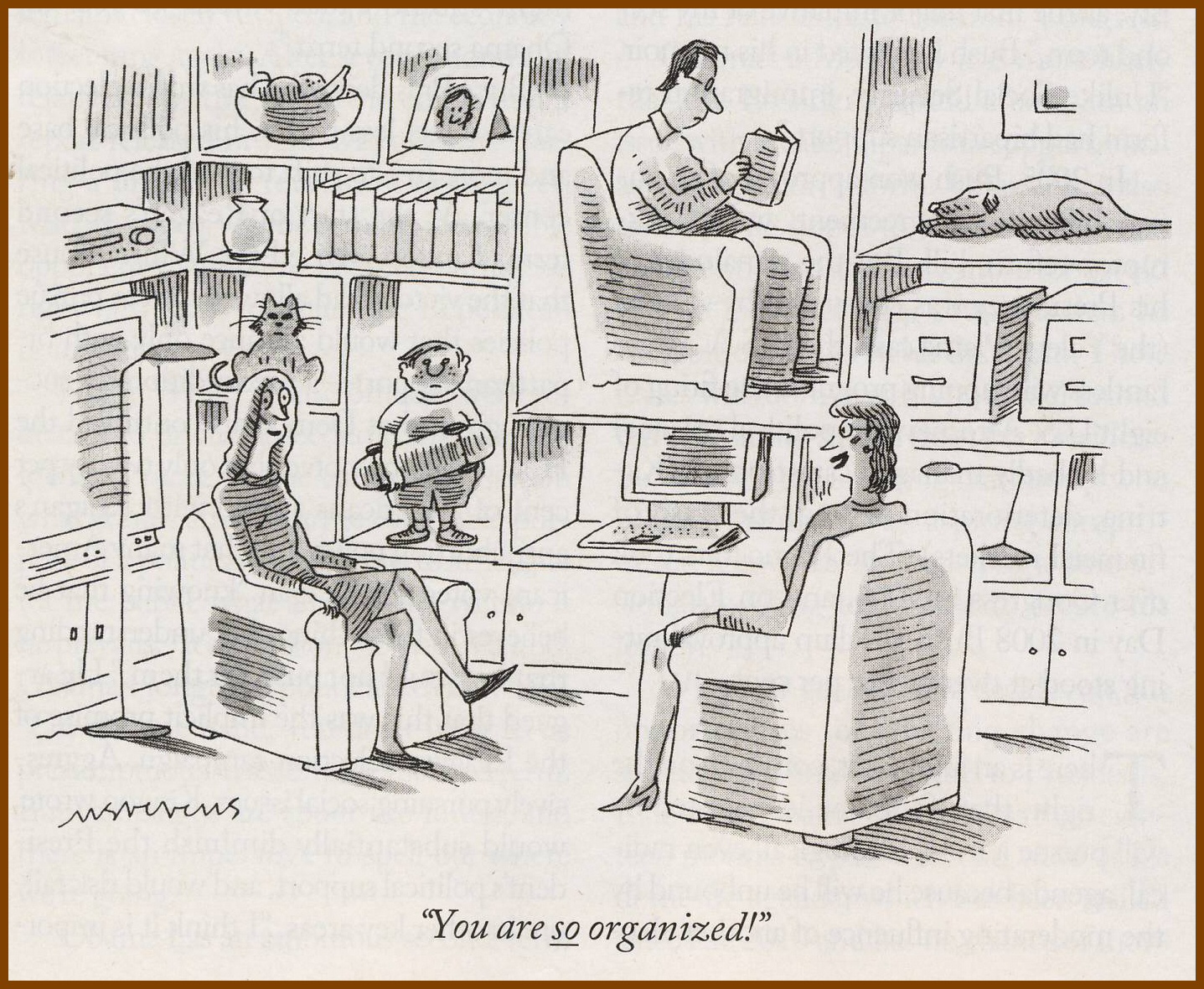
Type 5 Wife & Mother

This is the sixth in the series of Type Comics. See also Type 1, Type 2, Type 4, Type 7, and Type 9.

What do you think, maybe not so much organized as compartmentalized?

The Limits of Anxiety

Sure, everyone feels anxious at one time or another. There are situations and people and behaviors we’re quite right to feel uneasy or apprehensive about for all kinds of reasons. But the three Thinking center types know and live with anxiety on a different, more fundamental, level since anxiety (fear without a focal point) is their primary issue. Types 5, 6, and 7 each have a different focus for their anxiety (they fear different things) and deal with it differently, but all of them live with it to one extent or another.

Fear is a reaction to a perceived threat. It signals us that we’re in danger so we can react to the threat and save ourselves. If we succeed in saving ourselves, we’re no longer afraid because the threat is over. Anxiety, on the other hand, is a chronic state of worry. There’s no specific action we can take to resolve it because there’s no clearly identifiable threat. It’s kind of an anti-survival mechanism because over the long haul it can have deadly consequences. Continue reading

Start Your Engines

If nothing else, I can serve as a bad example. Back on 09/22/12, I kicked off my other blog, www.givemeadaisy.com, by describing how I had come up with a personal keyword theme for the season of autumn: velocity.

Velocity, of course, means speed, pace, swiftness, or rapidity. And that’s exactly what I had in mind: moving as fast as I could to get as much done as possible.

It took a couple of weeks before I realized the extent to which I’d put the cart before the horse by failing to specify a direction. Going for velocity without first identifying a destination—or having a vision of where I wanted to go—is akin to setting a driverless race car careening along a track at high speed. Derailment, or worse, is only a matter of time.

How perfectly like an 8, though. Speed over substance; quantity over quality. The whole thing really made me laugh at myself. It isn’t that I value speed or quantity over substance or quality. It’s just that it’s so much easier for me to go there. It’s easier for me to move. Move where? Anywhere! The direction is often less important than the motion.

I don’t recommend trying this at home.

Fortunately, I recognized my folly before I hit the rails or crashed and burned. I have since decided on a destination and laid in a course. All systems are go. At least now I’m a guided missile.

Deciphering the Ink Blots

What was once called the objective world is a sort of Rorschach ink blot, into which each culture, each system of science and religion, each type of personality, reads a meaning only remotely derived from the shape and color of the blot itself.

Lewis Mumford, scholar and writer, 1895-1990

Type 1: Embrace Your Inner Prodigal

1s want to do whatever they do correctly. They are driven to always be right, upright, (sometimes even righteous), as well as conscientious, ethical, and moral. They have an image of perfection they try to realize, and their fear is that they can’t measure up–they’re not good enough, proper enough, or conscientious enough to attain it.

So they strive mightily to prove to themselves and others how principled and ethical and responsible and hard-working they are. It can be a pretty tough row to hoe. Perfection is an ideal that is rarely fully realized in the real world. Chasing after it can make 1s very intense and sometimes even, dare we say, rigid.

If 1s accept the fact that, trite though it sounds, nobody’s perfect and it’s OK not to be (and do) right all the time, they may find it easier to relax a little and focus on the bigger picture. The same degree of scrutiny does not need to be applied to everyone and everything. Mistakes were made. Stitches were dropped. Commas were misplaced. Life is irregular and messy and imperfect. Sometimes that’s the best thing about it!

So if you’re a 1, let yourself go out and do something haphazardly or casually. You know you have it in you. Let yourself off the hook for your past transgressions. They’re what make you human. They’re what make it possible for other people to relate to you.

Your true value–what you have to offer the rest of us–doesn’t lie exclusively in crossing all the i’s and dotting all the t’s, except when you’re proofreading. Otherwise good enough is often good enough.

Next Friday: Type 2: Embrace Your Inner Pip-Squeak

Our “Fatal” Flaws

The words guilt and shame are often used interchangeably, but they have very different meanings. Guilt is the result of something we either did or didn’t do (if we believe we should have done it). In other words, guilt arises from an act we have some control over. The act or omission may be unintentional, but we were still the agent in the situation.

Shame relates to our sense of self, of who we are as a person, our very identity. Some of the things we’re ashamed of are things we may have no control over. People are often ashamed of some aspect of how they look (too short, too tall, freckles, thick ankles) or of their backgrounds, for example. We are often ashamed of our perceived flaws, whether those flaws are physical, mental, emotional, or some combination thereof.

Guilt and shame are both feelings. It’s definitely possible to feel both guilty and ashamed of something we did or didn’t do—especially when our actions seem to confirm our worst fears about ourselves. Continue reading

Ennea-Journaling Booklet FREE to Subscribers

Awareness. Self-Observation. Change. That’s what Ennea-Journaling is all about. So I’m happy to be able to offer a 32-page booklet filled with all kinds of journal writing exercises you can use with the Enneagram or to expand your existing journaling practice. You don’t have to be an Enneagram expert–or even know very much about it–in order to benefit from the many suggestions, keywords, and other prompts you’ll find inside.

Ennea-Journaling Exercises for All Types

This booklet is now available to everyone who subscribes to Nine Paths by email (see box on the right). Shortly after subscribing, you will receive the pdf file so you can download the booklet.

If you are already an email subscriber, you don’t have to do anything. I will send you the pdf document by email. If you don’t receive it, first check your spam folder. If it isn’t there, please let me know. You can email me at ninepaths@gmail.com.

WordPress Subscribers: If you would like the Ennea-Journaling booklet, please email me at ninepaths@gmail.com or subscribe via email.

I’m delighted to share this resource with you and I hope you will share it with others!

Unsuitable Job for a Type 5?

A few days ago, a friend and I drove to Santa Fe to have lunch at a place where I’ve eaten several times. The food is very good and reasonably priced, the view is calendar-picture perfect, and the service has always been fine. But this time, the service was not so fine.

The two of us had set out to have an early lunch. But after one mishap, a little dillydallying, and an unplanned side trip, by the time we got to the restaurant our early lunch had morphed into a late one. We were both pretty hungry, and I was in a state of caffeine deprivation. We were seated immediately—and then completely ignored. Servers passed us by, to and fro, but our server was nowhere to be seen. Enough time passed that I was about to go over and buy a to-go cup of coffee at the front of the restaurant.

He Makes an Entrance

When our server—a young man in his 20s—finally showed up in our general vicinity, he was moving with a pronounced limp. My dining companion, a Type 2, decided to give him a pass based on the limp. Continue reading

Type 9 Theme Song: Do It Anyway

My friend Donna, a Type 9, emailed me a link to this video. She said:

Speaking of voices in your head, this should be the theme song for 9s!

I agree. Besides, I’m a big Ben Folds fan, so I like the song anyway.