Category Archives: Type 5

In the Shadow of Type 5: Emptiness

Emptiness

Emptiness (Photo credit: herrnanditovsk)

5s like to see themselves as perceptive, logical, reasonable, observant, informed, deep, intelligent, self-sufficient, and objective. Others may see them essentially the same way but put a slightly different slant on those characteristics. They may view 5s as aloof, insensitive, in their heads, eccentric, and maybe even know-it-alls like Sheldon Cooper on TV’s The Big Bang Theory.

5s aren’t the only people who misunderstand how others perceive them, but because of the structure of their personalities they may be the most likely to do so—as well as the least likely to care. Since they prefer to avoid a lot of interpersonal contact, especially intimate contact, they aren’t bothered if their behavior keeps others away. Interacting with other people distracts 5s from what Riso and Hudson call the Inner Tinker Toy they have put together in their heads.

EXEMPLAR OF THE BOY SCOUT MOTTO

Be Prepared… the meaning of the motto is that a scout must prepare himself by previous thinking out and practicing how to act on any accident or emergency so that he is never taken by surprise.

–Robert Baden-Powell

Of course, it’s impossible to be prepared for anything and everything that could possibly occur. The definition of an emergency is that it is an unforeseen event that requires immediate action. An accident, too, is an unexpected, unintentional incident. But it’s hard for 5s to recognize, even in the normal course of events, when the time has come to stop preparing and to act.

I’ll Be in My Cave

In The Enneagram Spectrum of Personality Styles, Jerome Wagner names isolation as the primary defense mechanism for Type 5:

To avoid feeling empty, you isolate yourself in your head away from your feelings and people. You go to your thoughts where you feel full and comfortable. You also isolate or compartmentalize one time or period of your life from the next.

5s not only isolate in their heads, they often create personal spaces into which they retreat. These spaces are often an extension of 5s’ interests and fascinations, which they fill to the brim with materials, tools, books, etc., just as they fill their heads with information and knowledge. 5s are often as loathe to give up these material objects and their tinkering with them as they are to give up their incessant intake of information and mental activity. Both serve the same purpose: to avoid experiencing feeling empty.

QUIETING THE MIND

This suggestion from Don Riso and Russ Hudson in The Wisdom of the Enneagram focuses directly on the shadow issue of emptiness.

Remember that your mind is clearest and most powerful when it is quiet. Take the time to cultivate this quiet in yourself, and do not confuse it with an insistence that your external world be silent. Rather, learn to notice your nonstop internal commentary on all of your experiences. What arises when you simply take in an impression of the moment without connecting it with what you think you already know? Being connected with your physical sensations will greatly help you quiet your mind.

5s fill themselves up with so much information as a way to insulate, as well as isolate, themselves. But what happens is that they eventually lose touch somewhat with the actual world because in observing it from the safety of their minds, all they can see is the construct they have very carefully built up over time.

So practices that quiet the mind can be powerful antidotes to this escape from reality. But since escaping reality—or at least some portion of it—is what they have wanted to do all along, those practices can also be very threatening.

Working on a project with one or two other people is also a good practice. 5s do have lots of insight and expertise to offer. They can be excellent problem solvers, too. Engaging in an activity with someone else who shares one of their interests can be a grounding experience. It can also help 5s develop confidence in the area of interpersonal relations, which is a gateway to the wider world.

New Year’s Counter-Resolutions

Illustration Friday - Resolution

Resolution (Photo credit: The hills are alive)

Sometimes it’s best to be LESS than we can be, especially when it comes to the all-too-entrenched compulsions of our personality.

So here are some resolutions for the new year that run counter to our natural inclinations. If your past resolutions have worked as well as mine, you might be up for giving one or two of these a try.

Type 1:

  • Create a schedule for goofing off.
  • Make at least one mistake per day.
  • Let sleeping dogs lie.

Type 2:

  • Pamper myself, whether I feel like it or not.
  • Let them figure it out by themselves once in a while.
  • Start an argument just for the heck of it.

Type 3:

  • Make an anonymous charitable donation (and don’t tell anyone about it).
  • Leave the house without combing my hair.
  • Start having goal-less Wednesdays.

Type 4:

  • Lighten up!
  • Try doing one thing a week the way everyone else does it.
  • Take something at face value instead of searching for its deeper meaning.

Type 5:

  • Set up a meet and greet with the neighbors.
  • Next time, don’t read the instructions first.
  • At least once a month, throw something out.

Type 6:

  • Do whatever they least expect me to do.
  • Take a day off in the middle of the week for no reason.
  • Lower shields.

Type 7:

  • Just say “no.”
  • Finish one thing before starting something else.
  • Spend some quiet time alone without distractions.

Type 8:

  • Leave the office at quitting time—or before.
  • Find lower gear and occasionally shift into it.
  • Let the right one in.

Type 9:

  • Do whatever I feel like doing no matter how much chaos ensues as a result.
  • Give up being passive-aggressive for being outright aggressive.
  • Create a longer to-do list.

Happy New Year!

~ ~ ~

NOTE: As of January 2013, new Nine Paths posts will be published every Monday and Friday instead of every Monday, Wednesday, and Friday.

Make It So!

A derivative collage from two other files - ca...

Captain Jean Luc Picard on board the Enterprise (Photo credit: Wikipedia)

Jean Luc Picard was the captain of the Enterprise. So his directive to “make it so” was aimed at the people under his command in order to further some aspect of the starship’s current mission.

Each of us is on a mission, too, though probably not an interstellar one. And we give ourselves directives to keep focused on our particular mission.

Self Directives by Type

Type 1: Watch Yourself!

Type 2: Ignore Yourself!

Type 3: Distinguish Yourself!

Type 4: Be Yourself!

Type 5: Prepare Yourself!

Type 6: Brace Yourself!

Type 7: Enjoy Yourself!

Type 8: Push Yourself!

Type 9: Hide Yourself!

Type 5: Embrace Your Inner Blockhead

5s fear that they are inadequate (to a task, to a situation, sometimes even to life in general). To defend against this fear, they retreat into their heads—command central. From this safe vantage point, they intake information and attempt to use their mental faculties to process the stimuli presented by the outside world. 5s are very good at concepts, theories, figuring things out, and mastering a body of knowledge.

This works well enough if you’re trying to do the math, put together a puzzle, understand string theory, or absorb the works of Aristotle. It works less well if you’re trying to learn how to play guitar, repair the plumbing, or maintain any kind of personal relationship.

Since 5s do not like to be intruded upon, however, this may be a pretty good tactic as it does serve to put other people off. But spending all your time inside your own head can get lonely. And what’s the point of knowing so much about something if you don’t put that knowledge to practical use?

ANALYSIS PARALYSIS

One of the pitfalls 5s face is becoming immobilized because they don’t think they ever have enough information to make a decision or to act. This state of affairs both arises from the compulsion and contributes to it. It’s like a self-powered circuit that keeps the thinking process running long after it should have shut down.

When 5s embrace their inner blockhead, they can accept the fact that they aren’t—and don’t need to be—experts about everything. There are plenty of things they don’t know and never will know. But we’re all really in the same boat in that regard.

When 5s realize that thinking is not always the best way to deal with life—and, in fact, it’s sometimes the worst way to deal with it—they may be able to open themselves up to an entire new world of possibilities. Alternate realities, if you will. They may find that the material world has at least as much to offer them as does the cerebral world. They may find that it’s really not the end of the world to be wrong or misinformed or unprepared. These are some of the bases for humor in our society. Levity may not be the first word that comes to mind when thinking of 5s, but it’s a super duper circuit-breaker. And remember:

If you don’t have a sense of humor, you probably don’t have any sense at all.

Aphorism

Songs for the Road (the list)

If you’re travelin’, you need a road song, and everyone loves a good road song, right? But not everyone likes the same song or moves to the same beat. So here’s my list of road songs by type:

Type 1: The Higher You Climb (Dan Fogelberg)

You get a little bonus hit of Down the Road as an intro.

Type 2: I’ll Take you There (Staple Singers)

Type 3: I Can Walk on Water (Basshunter)

Type 4: Runnin’ Down a Dream (Tom Petty and the Heartbreakers)

Type 5: Boulevard of Broken Dreams (Green Day)

Type 6: Road to Nowhere (Talking Heads)

Type 7: I’ll Follow the Sun (the Beatles)

Type 8: I Can’t Drive 55 (Sammy Hagar)

Type 9: Every Day Is a Winding Road (Sheryl Crow)

Twisted Affirmations (Enneagram Humor)

English: Halloween in Bonaire.

HAPPY HALLOWEEN!

A student in a group I facilitated years ago (not the group pictured above) brought in a list of “twisted affirmations” she’d come across. As she read them aloud, we realized how easily they could be categorized by Enneagram type. So that’s what we did. There were many more affirmations than the nine below, but some types got off pretty easy while others seemed to come out far more “twisted.” So to keep it fair (I’m an 8, after all), I’ve chosen what seems to be the most representative twist for each type. I would love to credit the author, but I have no idea who he/she is.

Type 1
I am grateful that I am not as judgmental as all those censorious, self-righteous people around me.

Type 2
As I learn the innermost secrets of the people around me, they reward me in many ways to keep quiet.

Type 3
To have a successful relationship, I must learn to make it look like I’m giving as much as I’m getting.

Type 4
I can change any thought that hurts into a reality that hurts even more.

Type 5
I have the power to channel my imagination into ever-soaring levels of suspicion and paranoia.

Type 6
Only a lack of imagination saves me from immobilizing myself with imaginary fears.

Type 7
I am willing to make the mistakes if someone else is willing to learn from them.

Type 8
When someone hurts me, forgiveness is cheaper than a lawsuit, but not nearly as gratifying.

Type 9
False hope is nicer than no hope at all.

~ ~ ~

Sometimes you just need to be able to laugh at yourself.

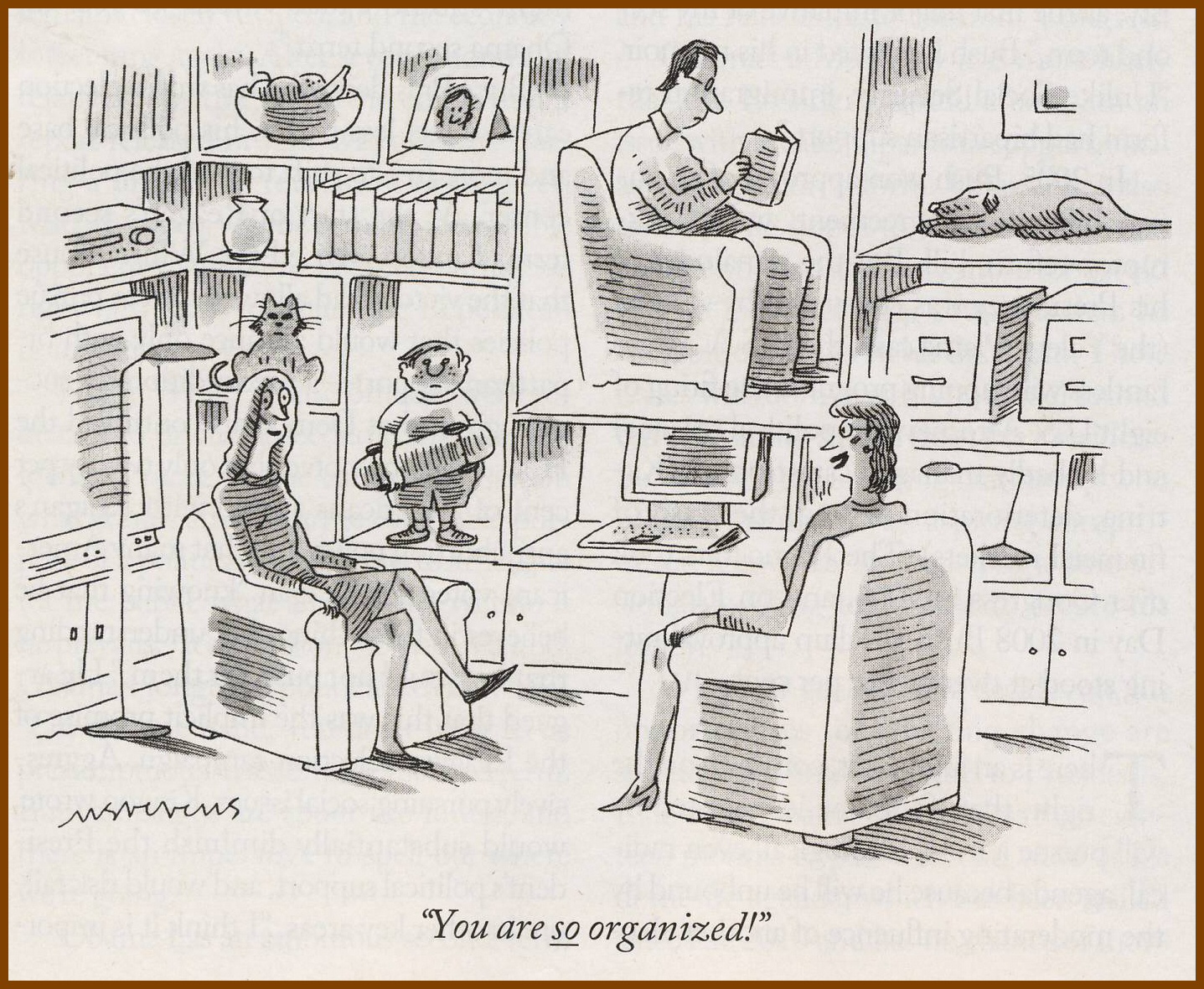
Type 5 Wife & Mother

This is the sixth in the series of Type Comics. See also Type 1, Type 2, Type 4, Type 7, and Type 9.

What do you think, maybe not so much organized as compartmentalized?

The Limits of Anxiety

Sure, everyone feels anxious at one time or another. There are situations and people and behaviors we’re quite right to feel uneasy or apprehensive about for all kinds of reasons. But the three Thinking center types know and live with anxiety on a different, more fundamental, level since anxiety (fear without a focal point) is their primary issue. Types 5, 6, and 7 each have a different focus for their anxiety (they fear different things) and deal with it differently, but all of them live with it to one extent or another.

Fear is a reaction to a perceived threat. It signals us that we’re in danger so we can react to the threat and save ourselves. If we succeed in saving ourselves, we’re no longer afraid because the threat is over. Anxiety, on the other hand, is a chronic state of worry. There’s no specific action we can take to resolve it because there’s no clearly identifiable threat. It’s kind of an anti-survival mechanism because over the long haul it can have deadly consequences. Continue reading

Our “Fatal” Flaws

The words guilt and shame are often used interchangeably, but they have very different meanings. Guilt is the result of something we either did or didn’t do (if we believe we should have done it). In other words, guilt arises from an act we have some control over. The act or omission may be unintentional, but we were still the agent in the situation.

Shame relates to our sense of self, of who we are as a person, our very identity. Some of the things we’re ashamed of are things we may have no control over. People are often ashamed of some aspect of how they look (too short, too tall, freckles, thick ankles) or of their backgrounds, for example. We are often ashamed of our perceived flaws, whether those flaws are physical, mental, emotional, or some combination thereof.

Guilt and shame are both feelings. It’s definitely possible to feel both guilty and ashamed of something we did or didn’t do—especially when our actions seem to confirm our worst fears about ourselves. Continue reading

Unsuitable Job for a Type 5?

A few days ago, a friend and I drove to Santa Fe to have lunch at a place where I’ve eaten several times. The food is very good and reasonably priced, the view is calendar-picture perfect, and the service has always been fine. But this time, the service was not so fine.

The two of us had set out to have an early lunch. But after one mishap, a little dillydallying, and an unplanned side trip, by the time we got to the restaurant our early lunch had morphed into a late one. We were both pretty hungry, and I was in a state of caffeine deprivation. We were seated immediately—and then completely ignored. Servers passed us by, to and fro, but our server was nowhere to be seen. Enough time passed that I was about to go over and buy a to-go cup of coffee at the front of the restaurant.

He Makes an Entrance

When our server—a young man in his 20s—finally showed up in our general vicinity, he was moving with a pronounced limp. My dining companion, a Type 2, decided to give him a pass based on the limp. Continue reading