Ennea-Journaling Daily Check-In

Journal writing takes all kinds of forms, from lengthy multi-part flow-writing exercises, to making lists, to using springboards and sentence prompts, to just splatting out whatever occurs to you. If you’re not in the habit of keeping a journal—or if you don’t think you have time or don’t know how to do it—the idea of starting one can seem daunting.

The Ennea-Journaling Daily Check-In is a great place to start. It’s structured in that it provides several prompts for each of the three centers. If you fill it out daily or a few days a week, over time you’ll likely begin to notice some patterns. Maybe you often have trouble coming up with something to write about one center, for example. Even though the Check-in doesn’t require a huge commitment of time, it still helps increase self-observation and self-awareness. And there’s a section at the bottom where you can declare your intentions for the following day.

You may decide you want to explore something from your Check-in at greater length, so it’s always good to have a notebook, pad of paper, or journal handy. The easiest way to expand your journaling is to write a topic sentence at the top of a page and flow-write for a page or two or set a timer for a certain amount of time (five or ten minutes is a good place to start).  Flow-writing requires only that you keep your pen or pencil moving across the paper. If you feel stuck, write that you’re stuck or write nonsense words. Eventually you’ll pick up the “flow” again. And you may be surprised to find out what comes out from the end of your pen.

Feel free to print and make as many copies of the Daily Check-in as you’d like.
The Centers: Doing, Feeling & Thinking

Maybe you know someone who tends to:

  • Jump in head first
  • Take the bull by the horns
  • Shoot first and ask questions later

Or someone else who’s more likely to:

  • Wear his heart on his sleeve
  • Have a heart of gold
  • Pour his heart out

Or another person who:

  • Has her head in the clouds
  • Lives in a world of her own
  • Suffers from “analysis paralysis”

Some people are quick to act or speak without thinking or taking other people’s feelings into consideration. Doing comes naturally to them. Some people feel things deeply themselves and are able to sense how others feel. Feeling comes naturally to them. And some people seem to spend the majority of time in their heads rather than in the so-called real world. Thinking comes naturally to them.

In Enneagram lingo, Doing, Feeling, and Thinking refer to different kinds of intelligence—different ways of absorbing, processing, and reacting to stimuli from our internal and external worlds. The idea of three different kinds of intelligence appeared to be supported by neuroscientist Paul MacLean’s theory that each of these types of intelligence is associated with a different part of our brain.  Continue reading

Remembering Mom

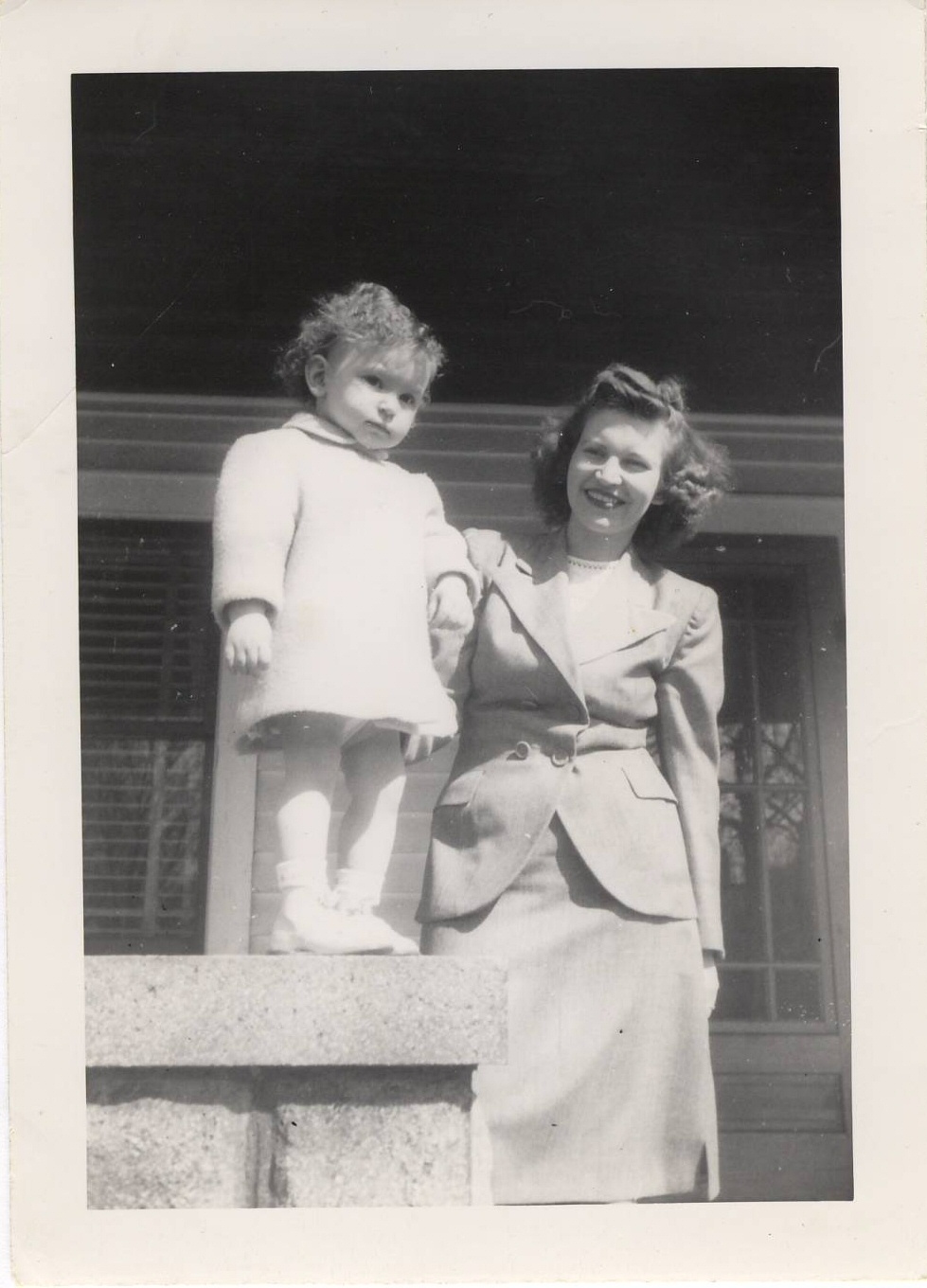
Apparently when she was born in 1917, my mother’s parents couldn’t afford a middle name for her. I think she was offended by that vacant spot—and probably even embarrassed. She righted the wrong when she received Confirmation in the Catholic Church and took her Confirmation name, Theresa, as her official middle name. She wore it proudly to the very end.

Color me Skeptical (age 1-1/2)

A few years before she died, my mother completed an Enneagram test and readily identified as a 9w1: a Withdrawing type with a Compliant wing. If only we’d known from the beginning that temperamentally-speaking we were two entirely different species, we might have grated on each other a little less. She never knew what to make of me, and I was equally perplexed by her. She tended to work herself up over what the neighbors might think about something. To be fair, ours was not the most conventional of families. But I couldn’t be bothered about what the neighbors might think.

Mom’s 1 wing asserted itself at the supermarket, where she wouldn’t allow me to put any of the groceries on the conveyor belt at check-out because everything had to be precisely placed in a particular sequence she was convinced I would mess up. Since I didn’t care enough to learn her system, I’m sure she was right. When we got home to unpack the bags, all the items had to be moved to their appropriate staging areas before anything could be put away. As a Doing type, I would have been happy to put the groceries away as she unpacked them. That would have been so much more efficient. But it wasn’t the “right” way, so we never did that.  Continue reading

The Nature/Nurture Continuum

The debate about how we become who we are used to be framed in either/or terms: nature versus nurture. To take the side of nature was to argue that our personalities and behaviors are entirely the result of our genetic inheritance, already fixed in place when we’re born. To take the side of nurture was to argue that nothing of our personalities and behaviors is present at birth; we are totally at the effect of our environment, our relationships, and the myriad of influences we experience growing up.

Both extremes always seemed fairly hopeless to me, each in a different way. Fortunately, there are no longer many people arguing exclusively for either side. It’s pretty commonly accepted that who we are is a result of both nature and nurture.

They’re the opposite ends of a continuum, sort of like the male and female brain I wrote about in my previous post. I don’t know that a formula exists to say this percentage of me (or you) is a result of nature and this percentage is a result of nurture. We all come into the world with some attributes, characteristics, and preferences in place. Depending on what they are and how strong they are, they may even override some aspects of nurture. On the other hand, for someone who’s forced to deal with extremely difficult circumstances (physical, mental, or emotional) as they’re growing up, nurture could have a more powerful effect than it might on someone raised under more favorable conditions.  Continue reading

Gender Stereotyping: Who Controls the Remote?

When it comes to the brain, clichés are never true.

                                                                                      Jonah Lehrer

Wielding control of the TV remote is one of the most recognizable cliché examples of male (dominance) behavior. But my partner of 30 years, who died in 2005, was a 4w5—a Withdrawing type with a Withdrawing wing—and since I’m an 8w7—an Aggressive type with an Aggressive wing—I was always the one firmly in control of the TV remote.

Our relationship never fit that Mars/Venus stereotyping that’s still popular in some circles. Withdrawing types tend to nurture the past in one way or another, and as a result, RC had much greater and more detailed recall about the events of our relationship than I did. He would wander off on verbal reveries about something or other we once did—or used to do regularly—assuming I shared those memories. But since I often had zero recall, I learned to keep my mouth shut or nod abstractedly. If I strained hard enough, I was sometimes able to bring up a fragment of the past that had been lost to me, which was always a huge surprise and slightly unnerving.

On the domestic front, I’m erratic at best. I enjoy decorating, but I hate cleaning, am indifferent about cooking, and find grocery shopping and doing dishes useless wastes of time. While RC wasn’t crazy about cleaning, either, he pulled his own weight. And he did the lion’s share of all those other tasks. He was an excellent cook, and he really enjoyed it. I’ve never prepared a Thanksgiving dinner in my life. But we had roasted turkey and all the trimmings every year we were together.

He once threatened to get me a T-shirt that said “I am not the nice lady”—and he meant it as a compliment. Continue reading

The Assemblage Point

[P]erception takes place because there is in each of us an agent called the assemblage point that selects internal and external emanations for alignment. The particular alignment that we perceive as the world is the product of the specific spot where our assemblage point is located on our cocoon.

Carlos Castaneda, The Fire From Within

I don’t know about cocoons, but I completely understand the concept of the assemblage point. It’s the unique perspective from which we view ourselves, other people, and the world at large. It’s the perspective from which we assemble the world. We aren’t aware we’re doing it. We don’t even know we have an assemblage point. We’re under the impression that what we see “out there” is simply what’s out there. We believe that the way we think and feel and respond is entirely appropriate to whatever it is we’re thinking and feeling about or responding to. The way those other people think and feel and respond, however, is obviously just plain wrong.

Assemblage point and Enneagram type are really pretty similar. They might even be exactly the same thing. And the purpose of identifying one’s assemblage point is the same as the purpose of identifying one’s Enneagram type: to recognize it in order to escape from its trap.

[F]irst of all, one must become aware that the world we perceive is the result of our assemblage point’s being located on a specific spot on the cocoon. Once that is understood, the assemblage point can move almost at will, as a consequence of new habits.

That makes it sound easy when, of course, it’s anything but. Continue reading