Category Archives: Type 8

Type 8: Embrace Your Inner Weak Sister

Powerful, I take responsibility for who I am, ...

(Photo credit: Tomas Sobek)

8s are pretty darn capable people. They will do whatever it takes to get the job done. Sometimes they will even do more than it takes. They are proud of being able to accomplish what they set out to do and of their ability to deal with adversity, challenges, and obstacles. 8s tend to feel as if they can weather whatever storm nature throws at them. If you are being treated unfairly—caught in a metaphorical or an actual storm—8s will also direct their considerable energy on your behalf.

But their tough exterior covers the same kind of fear every other type has, which is that deep down—or when push comes to shove—they are not all that. 8s whose identities are completely wrapped up in being a powerful force of nature expend quite a lot of energy proving it over and over again to themselves and to everyone else. Once is definitely not enough.

However, no man is an island—and no woman is, either. We are interdependent. We need each other. As far as 8s are concerned, it’s perfectly OK for someone else to be needy. But it’s definitely not OK for 8s to feel needy, actually be needy, or—horrors!—be seen as needy. It’s kind of the opposite situation to the boy who cried wolf. 8s do such a good job convincing everyone else of their hardiness and durability that others assume they don’t need help. Ever.

Notice that 8 over there who just fell through the ice? No worries. He’s got everything under control. See, he’s signaling that he’s just fine. Yes, he’ll be waving everyone off until the moment he slips under the ice and is gone, victim to his compulsion to always be the rescuer and never the one who is rescued.

It’s great to be able to tough things out, but it’s not so great to risk life and limb out of the compulsion to tough them out.

People…people Who Need People…*

One of the things 8s fail to recognize, in addition to the utter folly of their total commitment to their position, is that other people like to be needed. They appreciate being able to help each other. Another thing is that always being the one to lend a hand and never being willing to accept a hand creates an imbalance in all of one’s personal relationships. This ought to make an impact on 8s, who are greatly concerned with fairness and balance. Give and take—or give and accept—would make a good mantra for 8s.

When 8s embrace their inner Weak Sister (whether male or female), they can let down their guard and admit they don’t have every single thing under control. They may not be able to deal with a thing or two life throws at them. So once in a while, they could possibly use a little help from their friends. It’s OK to ask. When they do, they may be surprised to find out that expressing vulnerability does not knock them down a notch in everyone else’s eyes. It might even raise them up a notch or two.

*not an endorsement of the song
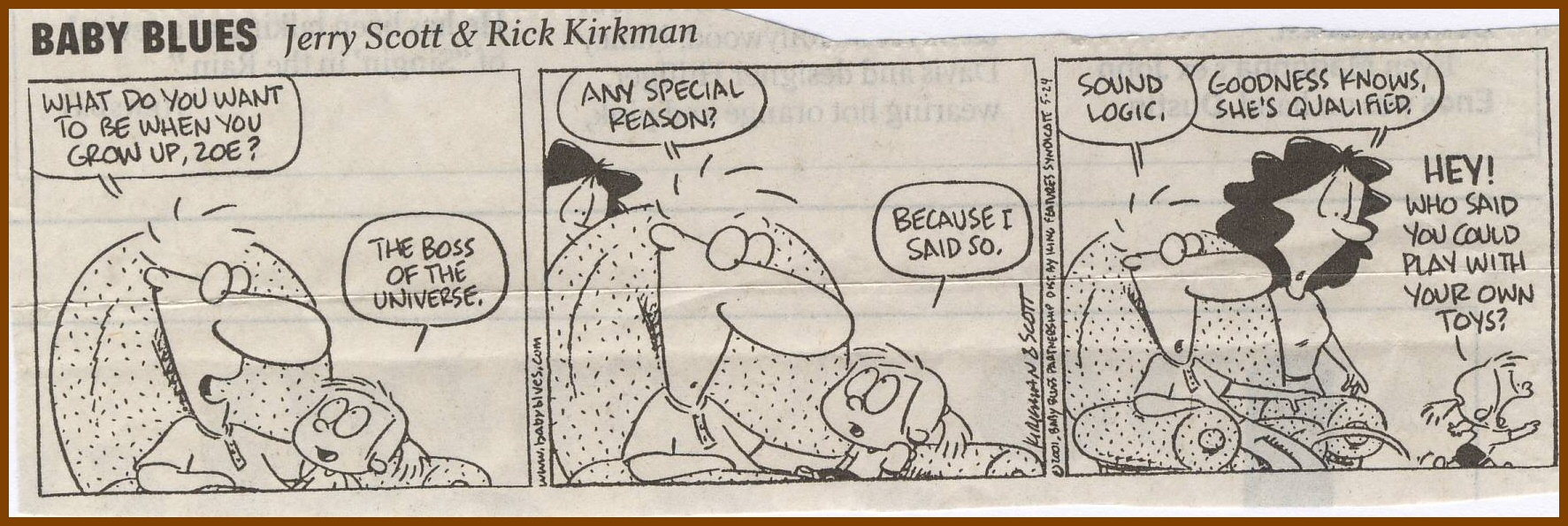
Type 8 Child

Most recent in the type comic series. See also: Type 1, Type 2, Type 4, Type 5, Type 7, and Type 9. (Types 3 and 6 coming soon .)

Gender Stereotyping Strikes Again

avid reader

avid reader (Photo credit: sekihan)

The New Yorker ran an article by Joan Acocella on 10/15/12 titled “Turning the Page: How women became readers,” in which she reviews “The Woman Reader,” by Belinda Jack. (See link below.)

I’ve been reading for enjoyment, information, and edification ever since I learned how to translate letters into words and words into meaning; it’s something I’ve always take for granted.

But for centuries women were widely forbidden to read. Thank Gutenberg for making books so easy to get that men gave up trying to keep women away from them. But there were still a few obstacles remaining before women gained free access to books. One of them was the 19th Century belief that women were prone to hysteria as a result of their “strong emotions.”

One London doctor wrote that female patients might be allowed fiction but should be carefully watched. If a novel seemed to worsen a woman’s condition, it should be taken away and replaced by “a book upon some practical subject; such, for instance, as beekeeping.”

However, the 19th Century is also when novels became hugely popular–and some of them were even written by women!

All well and good (and I highly recommend the article), but what does any of this have to do with the Enneagram? One paragraph in Acocella’s piece describes a 2004 study of 800 educated British adolescents, who were “asked to name their ‘watershed books,’ books that sustained them ‘through key moments of transition or crisis in their lives.'”

The results of the study purport to reveal how boys’ and girls’ reading choices differ in “stereotypical ways.”

The boys chose The Stranger, One Hundred Years of Solitudeand The Catcher in the Rye. The girls chose Jane Eyre, Pride and Prejudice, and Anna Karenina. (Acocella adds: “lest anyone doubt that women prefer tales of love and marriage.”)

Really? Really?

I don’t prefer tales of love and marriage. I’ve read all of those books, and I’m firmly in the boys’ camp as far as which ones had more of an influence on me. In fact One Hundred Years of Solitude is my favorite novel of all time.

Admittedly Enneagram type 3 or 8 women and Myers-Briggs type ENTJ women do not constitute the majority of women. But we do exist. And we do not conform to the stereotypes the psychologists and scientists and–now–writers keep trying to shove down our throats. The same goes for Enneagram type 2 or 4 men, who also exist and who also do not conform to gender stereotype.

Individual temperament–meaning personality type–is usually a more accurate indicator of a person’s habits and proclivities than whether that person is male or female. But gender stereotyping is easy. Understanding temperament is quite a bit more complex.

What book or books influenced you as a young reader?

Songs for the Road (the list)

If you’re travelin’, you need a road song, and everyone loves a good road song, right? But not everyone likes the same song or moves to the same beat. So here’s my list of road songs by type:

Type 1: The Higher You Climb (Dan Fogelberg)

You get a little bonus hit of Down the Road as an intro.

Type 2: I’ll Take you There (Staple Singers)

Type 3: I Can Walk on Water (Basshunter)

Type 4: Runnin’ Down a Dream (Tom Petty and the Heartbreakers)

Type 5: Boulevard of Broken Dreams (Green Day)

Type 6: Road to Nowhere (Talking Heads)

Type 7: I’ll Follow the Sun (the Beatles)

Type 8: I Can’t Drive 55 (Sammy Hagar)

Type 9: Every Day Is a Winding Road (Sheryl Crow)

Twisted Affirmations (Enneagram Humor)

English: Halloween in Bonaire.

HAPPY HALLOWEEN!

A student in a group I facilitated years ago (not the group pictured above) brought in a list of “twisted affirmations” she’d come across. As she read them aloud, we realized how easily they could be categorized by Enneagram type. So that’s what we did. There were many more affirmations than the nine below, but some types got off pretty easy while others seemed to come out far more “twisted.” So to keep it fair (I’m an 8, after all), I’ve chosen what seems to be the most representative twist for each type. I would love to credit the author, but I have no idea who he/she is.

Type 1
I am grateful that I am not as judgmental as all those censorious, self-righteous people around me.

Type 2
As I learn the innermost secrets of the people around me, they reward me in many ways to keep quiet.

Type 3
To have a successful relationship, I must learn to make it look like I’m giving as much as I’m getting.

Type 4
I can change any thought that hurts into a reality that hurts even more.

Type 5
I have the power to channel my imagination into ever-soaring levels of suspicion and paranoia.

Type 6
Only a lack of imagination saves me from immobilizing myself with imaginary fears.

Type 7
I am willing to make the mistakes if someone else is willing to learn from them.

Type 8
When someone hurts me, forgiveness is cheaper than a lawsuit, but not nearly as gratifying.

Type 9
False hope is nicer than no hope at all.

~ ~ ~

Sometimes you just need to be able to laugh at yourself.

Start Your Engines

If nothing else, I can serve as a bad example. Back on 09/22/12, I kicked off my other blog, www.givemeadaisy.com, by describing how I had come up with a personal keyword theme for the season of autumn: velocity.

Velocity, of course, means speed, pace, swiftness, or rapidity. And that’s exactly what I had in mind: moving as fast as I could to get as much done as possible.

It took a couple of weeks before I realized the extent to which I’d put the cart before the horse by failing to specify a direction. Going for velocity without first identifying a destination—or having a vision of where I wanted to go—is akin to setting a driverless race car careening along a track at high speed. Derailment, or worse, is only a matter of time.

How perfectly like an 8, though. Speed over substance; quantity over quality. The whole thing really made me laugh at myself. It isn’t that I value speed or quantity over substance or quality. It’s just that it’s so much easier for me to go there. It’s easier for me to move. Move where? Anywhere! The direction is often less important than the motion.

I don’t recommend trying this at home.

Fortunately, I recognized my folly before I hit the rails or crashed and burned. I have since decided on a destination and laid in a course. All systems are go. At least now I’m a guided missile.

Our “Fatal” Flaws

The words guilt and shame are often used interchangeably, but they have very different meanings. Guilt is the result of something we either did or didn’t do (if we believe we should have done it). In other words, guilt arises from an act we have some control over. The act or omission may be unintentional, but we were still the agent in the situation.

Shame relates to our sense of self, of who we are as a person, our very identity. Some of the things we’re ashamed of are things we may have no control over. People are often ashamed of some aspect of how they look (too short, too tall, freckles, thick ankles) or of their backgrounds, for example. We are often ashamed of our perceived flaws, whether those flaws are physical, mental, emotional, or some combination thereof.

Guilt and shame are both feelings. It’s definitely possible to feel both guilty and ashamed of something we did or didn’t do—especially when our actions seem to confirm our worst fears about ourselves. Continue reading

One of the Voices in Your Head…

…is undoubtedly that of your Inner Critic, who makes sure you’re aware whenever you fall short of its high expectations. Of course, since the Inner Critic is a part of you, the expectations are really your own. What those expectations are and how you came to take them on may be easily explained or may take several determined years of therapy to get to the bottom of.

I’ve never been convinced it’s actually possible to figure out what caused what, psychologically speaking. There are simply too many factors, too many things we don’t yet know about ourselves—scientifically, psychologically, and sociologically, let alone about our personal histories—to ever be able to say we know absolutely, positively, without a doubt that the reason we think or do thing A is because thing B happened to us when we were six years old. The influence of Rene Descartes to the contrary, we are not the equivalent of machines, either physiologically or psychologically, and using that model on ourselves isn’t particularly useful or effective. In addition to that, our memories are notoriously inaccurate in regard to both significant and insignificant events.

Yes, it’s comforting to think we know. As a species we like mysteries, but only when they’re solved in books or on screen. Continue reading

Songs for the Road: Doing Center

There was a great little piece in the Enneagram Monthly some 15 years ago called “Enneagram Voicemail Codes,” by Lahar Goldberg. It was short, succinct, laugh-out-loud funny—and painfully accurate. As Sheldon said when he explained a joke on the TV show The Big Bang Theory: “It’s funny because it’s true.”

Enneagram Voicemail Codes

If you know exactly what you want…press 1
If you want to help, press…2
If you have a great idea that could make us a lot of money…press 3
If you’re feeling abandoned…press 4
If you don’t want to talk to anyone…press 5
If you don’t know what you want…press 6
For a good time…press 7
If you want to tell us what to do and how to do it…press 8
If you feel irritated, but you need to take a nap…press 9

So I thought it would be amusing and maybe even somewhat illuminating to compile, with a little help from my friends, a list of traveling songs for each type.

Because there are three Centers of Intelligence within the Enneagram and three types within each center, I’ve decided to focus first on the three Doing center types and cover the Feeling center types and Thinking center types in subsequent posts.

Road Songs for Doing Center Types

Maybe it’s because I’m a Doing type, but nine points or nine lenses or even nine types all seem entirely too static—thus the name for the blog, Nine Paths. I think the Enneagram describes the different approaches we take to life and the different ways in which we move through it. Type influences the paths we take, as well as how we proceed along them and what we see on the way. So as we travel our respective paths, let’s queue up some type-appropriate road songs. [As a Type 8 with a strong 7 wing, my own impulse is to keep moving, but to enjoy the ride as much as possible.] Continue reading

My Friend, John

John is my friend Donna’s son, who celebrated his 11th birthday yesterday. He was born just a few months before I moved from California to New Mexico, so although I visit them occasionally (not nearly as often as I’d like), I’ve been present for approximately .0000001 percent of his life—or something like that, math not being my strong suit.

But John is clearly another 8w7. I totally grok him and get a huge charge out of seeing how similar he is to me.

WORDs, Words, Words

A couple of weeks ago, I got this email from his mother:

Quizzing John for his final in grammar. Pretty solid except he could not get the definition of COMPLY to save his life. Repeated efforts resulted in plenty of anger towards me. I was laughing on the inside. Continue reading