Ennea-Journaling the Aggressive Stance

Aggressive types come in all shapes, sizes, and packages. Sure they can be loud, obnoxious, and bombastic, but they can also be deceptively mild-mannered. No matter what their outward appearance and demeanor may be, Aggressive types all have a steely determination when it comes to going after what they want.

We will either find a way or make one.

— Hannibal

Are you only too familiar with what it’s like to take the Aggressive stance—either because you do or because you live, work, or otherwise spend time with an Aggressive type? Or does the concept of taking this stance seem not only alien but more than a little frightening?

Everyone accesses the Aggressive stance to some degree or in some situations. But for those types who access it the least often, the idea of developing it or even trying it on for size can seem daunting—and not necessarily appealing. But journal writing on this subject has a proven safety record.*

Here are some topics to use for journaling with a focus on the Aggressive stance—whether it’s your stance or not. In fact, if it isn’t your stance, but it’s the stance of someone you know, try writing one of the exercises from that person’s perspective. For flow-writing, set a timer, write the topic sentence at the top of a page, and then start writing. Keep your pen on the paper, even if you get stuck. If you still have more to write when your timer goes off, just keep going. Continue reading
Changes in Attitudes … Changes in Latitudes

The word “stance” usually refers to some kind of motionless or standing posture. So it’s an interesting choice of word to describe three different ways of moving. Instead of stances, we’re actually talking about different approaches. But we’re sort of stuck with the vocabulary at this point—at least I am.

The stance we take—moving against (Aggressive), moving away from (Withdrawing), or moving toward (Compliant)—is basic to who we are and underlies our automatic responses and reactions to the world around us and to the other people in our lives. Although it’s true we access the other two stances occasionally, the stance our type takes is our “go to” stance—the approach we fall back on, especially under pressure or in unfamiliar or uncomfortable situations.

 Moving Against
Fighting
The Aggressive types (3, 7, and 8) generally take a direct approach,
moving against what gets in the way of what they want.

Moving Away From
Keeping to Oneself
The Withdrawing types (4, 5, and 9) turn inward to find fulfillment,
moving away from what disturbs them.

Moving Toward
Giving in to Others
The Compliant types (1, 2, and 6) tend to seek a point of reference outside themselves, moving toward what will help them earn what they need. Continue reading

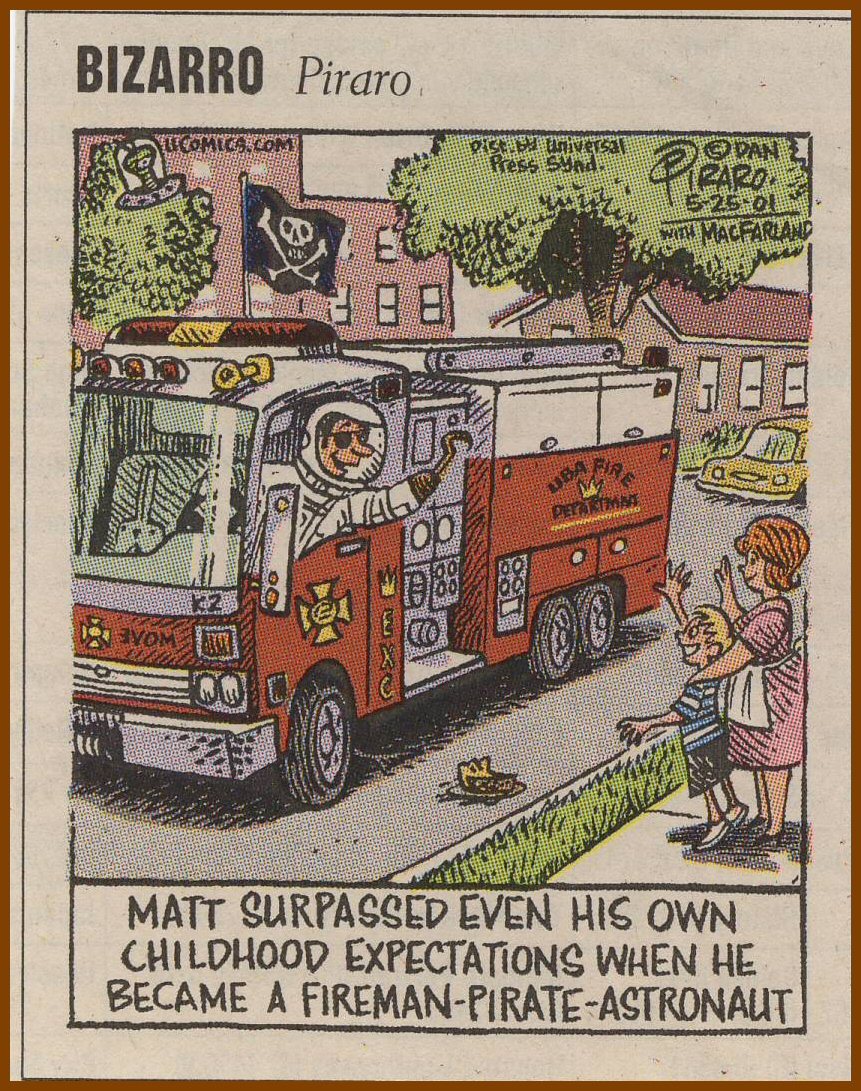
Type 7 Career Guy

Sometimes a comic (strip or single panel) really nails it. I guess that’s why they’re still around. I’ve found at least one for each type, so if this isn’t you, just wait. Yours is coming.

Self-Observation Isn’t for Wimps

In order to get past the limitations of our particular type, we need to be able to observe our own habitual thoughts, feelings, and behaviors. But observing ourselves doesn’t come naturally. It isn’t that we lack opportunity, since the object of self-observation is always available. It’s that we find it difficult to observe any aspect of ourselves—from the most significant to the most trivial—without having an opinion about it.

We like it or dislike it, approve of it or disapprove of it, want to keep it or get rid of it—or get more of it. We find it satisfying (occasionally) or dissatisfying (more often). What we observe puffs us up or deflates us. Not only are we constantly evaluating whatever catches our attention, but the same attribute, behavior, feeling, or thought can be judged acceptable in one instance and unacceptable in another. The criteria we use for our self-evaluations are based in compulsion, so there is no rest for the weary—meaning each of us is just another moving target for self-judgment.

Most of the time, we use our self-observations to identify how and where we need to be fixed, so we can improve ourselves. Alternatively, if we like what we observe, we congratulate ourselves. Continue reading

Creative Process Exercises (Step 3)

Manifestation is the third step in the creative process. It generally takes a lot longer to complete than the other two steps. Depending on what you’re creating, you may never be finished with it. Once you set out on the path to create something new, you begin to alter your reality. You start to receive information in the form of feedback, successes, failures, unexpected opportunities, or unanticipated obstacles. Any or all of that information can lead to discoveries and innovations. The creative process is dynamic rather than static. So use what you get to adjust your goals or reaffirm them.

Manifestation

This is where you get down to the nitty-gritty and figure out exactly what it’s going to take to realize your dream or accomplish your goal and then take practical steps to get there. You’ll need a plan. And you’ll need commitment. But you’ll also need to be observant and flexible. Continue reading

Creative Process Exercises (Step 2)

Visualization is the second step in the creative process. All the steps are equally important and it’s best to take time with each of them, but slowing down may be even more important at Step 2 than at the other steps. So make sure you give this stage ample time.

At first, the brain lavishes the scarce resource of attention on a single problem. But, once the brain is sufficiently focused, the cortex needs to relax in order to seek out the more remote association in the right hemisphere, which will provide the insight.

Jonah Lehrer, Imagine–How Creativity Works

Visualization

Think of Step 1 as the large opening at the top of a funnel into which you throw everything imaginable and then some. Step 2 is the narrow tube that slows down the flow of ideas. Slowing down helps you weed out the shoulds so you can get to the juicy stuff. Try your ideas on to see if they fit you. Are your goals personally meaningful to you and consistent with your values? Visualization utilizes soft—as opposed to hard—thinking. Continue reading

Creative Process Exercises (Step 1)

There are lots of creativity exercises that can be found in books or on the internet and classes you can take to enhance your creativity. Many of them are geared toward helping you develop a creative approach to your work or personal life. Others seem to be directed at helping you solve problems creatively. That’s different from creating—making something from nothing.

The creative process works best when you complete the three steps—conceptualization, visualization, and manifestation—in order. And creativity exercises seem to be more effective if they’re matched to the appropriate step in the process. With that in mind, here are some exercises that lend themselves to Step 1.

Conceptualization

At the conceptualization step, you want to give your Inner Critic the day or the week off so it doesn’t prematurely shoot down your ideas. Delete the words “practical” and “realistic” from your vocabulary. When you think you’ve exhausted the possibilities, keep going. That’s often the point where you strike gold. Continue reading

Something from Nothing: The Creative Process

Lots of people have identified the three steps of the creative process, and they’ve used various terms to describe them. I call them conceptualization, visualization, and manifestation. These three steps map remarkably closely onto the three Centers of Intelligence of the Enneagram: Thinking, Feeling, and Doing.

To use the creative process effectively, we need to fully engage with and complete each step in the appropriate sequence. But since none of us accesses all three centers equally, we tend to give insufficient attention to one or more of the steps, combine or confuse steps, or try to complete them out of sequence. I’ve seen–and experienced–how we tend to get stuck at the step of the creative process that relates to the Center of Intelligence we’re least comfortable with. But if creating were easy, I guess we’d all be masters of the process already.

The Three Steps and the Three Centers

Here’s how the steps of the creative process correlate with the Centers of Intelligence.

Continue reading

Why Explore the Enneagram?

Click here for 5 reasons.

My Friend, John

John is my friend Donna’s son, who celebrated his 11th birthday yesterday. He was born just a few months before I moved from California to New Mexico, so although I visit them occasionally (not nearly as often as I’d like), I’ve been present for approximately .0000001 percent of his life—or something like that, math not being my strong suit.

But John is clearly another 8w7. I totally grok him and get a huge charge out of seeing how similar he is to me.

WORDs, Words, Words

A couple of weeks ago, I got this email from his mother:

Quizzing John for his final in grammar. Pretty solid except he could not get the definition of COMPLY to save his life. Repeated efforts resulted in plenty of anger towards me. I was laughing on the inside. Continue reading