Gender Stereotyping Strikes Again

avid reader

avid reader (Photo credit: sekihan)

The New Yorker ran an article by Joan Acocella on 10/15/12 titled “Turning the Page: How women became readers,” in which she reviews “The Woman Reader,” by Belinda Jack. (See link below.)

I’ve been reading for enjoyment, information, and edification ever since I learned how to translate letters into words and words into meaning; it’s something I’ve always take for granted.

But for centuries women were widely forbidden to read. Thank Gutenberg for making books so easy to get that men gave up trying to keep women away from them. But there were still a few obstacles remaining before women gained free access to books. One of them was the 19th Century belief that women were prone to hysteria as a result of their “strong emotions.”

One London doctor wrote that female patients might be allowed fiction but should be carefully watched. If a novel seemed to worsen a woman’s condition, it should be taken away and replaced by “a book upon some practical subject; such, for instance, as beekeeping.”

However, the 19th Century is also when novels became hugely popular–and some of them were even written by women!

All well and good (and I highly recommend the article), but what does any of this have to do with the Enneagram? One paragraph in Acocella’s piece describes a 2004 study of 800 educated British adolescents, who were “asked to name their ‘watershed books,’ books that sustained them ‘through key moments of transition or crisis in their lives.'”

The results of the study purport to reveal how boys’ and girls’ reading choices differ in “stereotypical ways.”

The boys chose The Stranger, One Hundred Years of Solitudeand The Catcher in the Rye. The girls chose Jane Eyre, Pride and Prejudice, and Anna Karenina. (Acocella adds: “lest anyone doubt that women prefer tales of love and marriage.”)

Really? Really?

I don’t prefer tales of love and marriage. I’ve read all of those books, and I’m firmly in the boys’ camp as far as which ones had more of an influence on me. In fact One Hundred Years of Solitude is my favorite novel of all time.

Admittedly Enneagram type 3 or 8 women and Myers-Briggs type ENTJ women do not constitute the majority of women. But we do exist. And we do not conform to the stereotypes the psychologists and scientists and–now–writers keep trying to shove down our throats. The same goes for Enneagram type 2 or 4 men, who also exist and who also do not conform to gender stereotype.

Individual temperament–meaning personality type–is usually a more accurate indicator of a person’s habits and proclivities than whether that person is male or female. But gender stereotyping is easy. Understanding temperament is quite a bit more complex.

What book or books influenced you as a young reader?

Type 5: Embrace Your Inner Blockhead

5s fear that they are inadequate (to a task, to a situation, sometimes even to life in general). To defend against this fear, they retreat into their heads—command central. From this safe vantage point, they intake information and attempt to use their mental faculties to process the stimuli presented by the outside world. 5s are very good at concepts, theories, figuring things out, and mastering a body of knowledge.

This works well enough if you’re trying to do the math, put together a puzzle, understand string theory, or absorb the works of Aristotle. It works less well if you’re trying to learn how to play guitar, repair the plumbing, or maintain any kind of personal relationship.

Since 5s do not like to be intruded upon, however, this may be a pretty good tactic as it does serve to put other people off. But spending all your time inside your own head can get lonely. And what’s the point of knowing so much about something if you don’t put that knowledge to practical use?

ANALYSIS PARALYSIS

One of the pitfalls 5s face is becoming immobilized because they don’t think they ever have enough information to make a decision or to act. This state of affairs both arises from the compulsion and contributes to it. It’s like a self-powered circuit that keeps the thinking process running long after it should have shut down.

When 5s embrace their inner blockhead, they can accept the fact that they aren’t—and don’t need to be—experts about everything. There are plenty of things they don’t know and never will know. But we’re all really in the same boat in that regard.

When 5s realize that thinking is not always the best way to deal with life—and, in fact, it’s sometimes the worst way to deal with it—they may be able to open themselves up to an entire new world of possibilities. Alternate realities, if you will. They may find that the material world has at least as much to offer them as does the cerebral world. They may find that it’s really not the end of the world to be wrong or misinformed or unprepared. These are some of the bases for humor in our society. Levity may not be the first word that comes to mind when thinking of 5s, but it’s a super duper circuit-breaker. And remember:

If you don’t have a sense of humor, you probably don’t have any sense at all.

Aphorism

Hype-Hype-Hyperreality

Fragment of hyperreality . .

Fragment of hyperreality . . (Photo credit: jef safi \ ‘pictosophizing)

4s don’t have a lock on creativity, but it’s pretty widely accepted that they do at least have an edge on it. There are several reasons why that’s so, one of them being that 4s tend to hang around on the outskirts of things, which gives them a—yes—unique perspective. Another is that they are more immersed in the search for meaning than many of the rest of us are.

But here’s another explanation for it, from the pages of The Fire in Fiction by Donald Maass:

The world of a story is a hyperreality. In a passionately told tale, characters are larger than life, what’s happening matters profoundly, the outcome is important in the extreme, and even the words on the page have a DayGlo fluorescence.

Sound like the world of anyone you know? According to Don Riso and Russ Hudson’s profile of Type 4 in Personality Types: Using the Enneagram for Self Discovery, 4s “heighten reality through fantasy, passionate feelings, and the imagination.”

The world of story is tailor-made for 4s. While the rest of us who strive—or whose compulsion it is—to be balanced or reserved have to make an effort to ramp up the emotional content of our stories and exaggerate the plights of our characters, 4s are already living hyperreal lives. It’s what comes naturally. We may brush off their extremes of angst and ecstasy, but if we want to express our own creative impulses in a way that moves other people, we might want to be less dismissive.

Maass’s advice for people who find themselves cruising along, “no particular worries, everything going pretty well” is to:

[S]top working on your manuscript immediately. You could be in terrible danger. Why? You may be seeing the world and its woes in a way that is calm and rational. Nothing could be worse, at least for your fiction.

Go for It!

There’s something really wonderful each type has to offer that the other types are missing. We can take a lesson from 4s in how to get inside a story and wring out every last drop of passion from it. Mundane and workaday don’t cut it. Fiction has to be larger than life in order to seem true to life. The same applies to other forms of creative expression. It might help to be able to step into a 4‘s shoes and walk a few miles. Or tread. Or stride. Or saunter. Maybe meander. Or possibly promenade.

Songs for the Road (the list)

If you’re travelin’, you need a road song, and everyone loves a good road song, right? But not everyone likes the same song or moves to the same beat. So here’s my list of road songs by type:

Type 1: The Higher You Climb (Dan Fogelberg)

You get a little bonus hit of Down the Road as an intro.

Type 2: I’ll Take you There (Staple Singers)

Type 3: I Can Walk on Water (Basshunter)

Type 4: Runnin’ Down a Dream (Tom Petty and the Heartbreakers)

Type 5: Boulevard of Broken Dreams (Green Day)

Type 6: Road to Nowhere (Talking Heads)

Type 7: I’ll Follow the Sun (the Beatles)

Type 8: I Can’t Drive 55 (Sammy Hagar)

Type 9: Every Day Is a Winding Road (Sheryl Crow)

Type 4: Embrace Your Inner Everyman

Boat of Boredom

Boat of Boredom (Photo credit: Wikipedia)

Have you ever met a Type 4 that couldn’t construct an entire mountain range out of a pebble in the road? Me either. For 4s, there’s always a deeper level of meaning, if not actually a hidden meaning, to almost everything that is said or done or observed. Without it, life would be, well, boring. And boredom is the fate worse than death for 4s. Better to be abjectly miserable than be bored.

4s have extremely active imaginations, which is one of the reasons they tend to be very creative. But one of the ways they misuse their imagination is to interpret an event (especially one involving other people), draw a conclusion, and then act as if the imagined scenario is uncontested fact. They usually accomplish this without going to the trouble of checking in with the other parties involved as to their intentions. This can lead to all kinds of misunderstandings, ruptured relationships, hurt feelings, etc., keeping the emotional pot whipped into a frenzied froth. So drama abounds in the lives of 4s, whether real or manufactured, and they of course are at the center of the drama.

One of the driving forces in the compulsion of 4s is their need to believe they are unique and special. They are exempt from the rules; they deserve special treatment; they can’t be expected to behave like everyone else. Yet they crave acknowledgement and intimacy and fear rejection (which they are quick to identify even when it isn’t there). Trying to maintain a position as both an outsider and an intimate sounds exhausting. One of the personal prices 4s pay for being in the grip of their compulsion is depression.

Come as You Are

What happens when 4s recognize that, although they are indeed special in some ways, there are other ways in which they are just like everyone else? One thing they discover is that they don’t have to put so much energy into creating a unique image so instead they can put that energy to more truly creative uses. They may also find out that they can relate to people more easily, that much of the rejection they “experience” is in the eye of the beholder, and that intimacy and drama are not synonymous.

When 4s embrace their Inner Everyman, they can stop trying so hard to project and protect their image. They can come as they are to the party the common folk are throwing. They will always be recognized and appreciated for the unique qualities they contribute, but they won’t have to hang out on the sidelines forever, sitting out all the dances.

Twisted Affirmations (Enneagram Humor)

English: Halloween in Bonaire.

HAPPY HALLOWEEN!

A student in a group I facilitated years ago (not the group pictured above) brought in a list of “twisted affirmations” she’d come across. As she read them aloud, we realized how easily they could be categorized by Enneagram type. So that’s what we did. There were many more affirmations than the nine below, but some types got off pretty easy while others seemed to come out far more “twisted.” So to keep it fair (I’m an 8, after all), I’ve chosen what seems to be the most representative twist for each type. I would love to credit the author, but I have no idea who he/she is.

Type 1
I am grateful that I am not as judgmental as all those censorious, self-righteous people around me.

Type 2
As I learn the innermost secrets of the people around me, they reward me in many ways to keep quiet.

Type 3
To have a successful relationship, I must learn to make it look like I’m giving as much as I’m getting.

Type 4
I can change any thought that hurts into a reality that hurts even more.

Type 5
I have the power to channel my imagination into ever-soaring levels of suspicion and paranoia.

Type 6
Only a lack of imagination saves me from immobilizing myself with imaginary fears.

Type 7
I am willing to make the mistakes if someone else is willing to learn from them.

Type 8
When someone hurts me, forgiveness is cheaper than a lawsuit, but not nearly as gratifying.

Type 9
False hope is nicer than no hope at all.

~ ~ ~

Sometimes you just need to be able to laugh at yourself.

Anxiety Redux: Zebras & Roller Coasters

American biologist and author Robert Sapolsky.

American biologist and author Robert Sapolsky. (Photo credit: Wikipedia)

Since writing my post on The Limits of Anxiety last week, I had an opportunity to watch the 2008 National Geographic documentary Stress: Portrait of a Killer (on my computer, thanks to Open Culture). The program features Stanford biologist Robert Sapolsky, author of Why Zebras Don’t Get Ulcers.

Sure, just about everyone knows that being in a continually heightened state of anxiety can lead to physical stress symptoms, some of which can be quite severe. But this is another case when knowing something—as in having good information that we believe to be accurate—and being able to do something about it is much easier said than done.

Knowing (Thinking center) is only the first step. The next step is accepting on an emotional level that what we know matters to us personally (Feeling center). The third step is taking action (Doing center).

Although the three Thinking types may be more prone to experiencing anxiety because of the nature of their personalities or temperament, anyone can be afflicted with chronic or prolonged anxiety. Given the problems we face on a personal, local, and even global level, maybe the surprise is that everyone isn’t totally paralyzed by anxiety. So kudos if you’re not!

However, anxiety and stress are insidious, and I think we all live with unrelieved stress to one degree or another. Chalk some of that up to the fact that—unlike zebras—we can imagine things that don’t yet exist. We can—and do—anticipate the future, envisioning many different potential scenarios and outcomes. Those are great abilities to have in terms of being creative or in brainstorming or in planning ahead. But they also make us vulnerable to conjuring up negative possibilities and then convincing ourselves those things are likely to happen.

Anxiety can become a way of life that ultimately makes it more difficult for us to think clearly or react appropriately to the circumstances or events in our lives. So we need to be able to recognize when we get on the anxiety roller coaster and find a way to interrupt the ride. Actually a ride on a real roller coaster might be the perfect interruption.

In the meantime, please watch the video.

You might also like How to Avoid Stress.

Type 3: Embrace Your Inner Underachiever

To say that 3s want to succeed is like saying that penguins kinda sorta might like to get to their breeding grounds if it’s not too much trouble (see March of the Penguins).  3s are not only determined to succeed in all areas of their lives, they are also driven to avoid both the experience and the appearance of failing. Because 3s are the type most caught up in the issue of image–constantly trying to project an image both internally (to themselves) and externally (to everyone else)–experience and appearance become somewhat undifferentiated.

Wanting to achieve great things, being highly motivated, and working extra hard in order to succeed are all admirable qualities. No one wants to belong to the losers’ club. But too much single-minded devotion to the pursuit of achievement can easily become too much of a good thing.

By constantly measuring the value of their lives according to a pass/fail grading system, 3s risk missing out on so much that is not measurable by that yardstick. By screening out evidence of perceived failure–the thing they are most afraid of admitting–they risk denying their own experience. By attempting to mold themselves into a laudable persona according to other people’s definitions, they risk losing themselves to themselves. By always striving to achieve more and more on the success treadmill, they risk remaining forever unsatisfied and restless.

If 3s learn to embrace their Inner Underachiever and let go of the need to rise to the top in everything they do, they might be able to open themselves up to a totally different kind of success. They might be able to graciously sit one out now and then and let someone else get the win. They might be able to let down their guard, relax, and do something just for fun. They might find out that losing once in a while (or at least not always winning) makes it easier for people to relate to them. They might succeed in finding out who they really are.

Type 5 Wife & Mother

This is the sixth in the series of Type Comics. See also Type 1, Type 2, Type 4, Type 7, and Type 9.

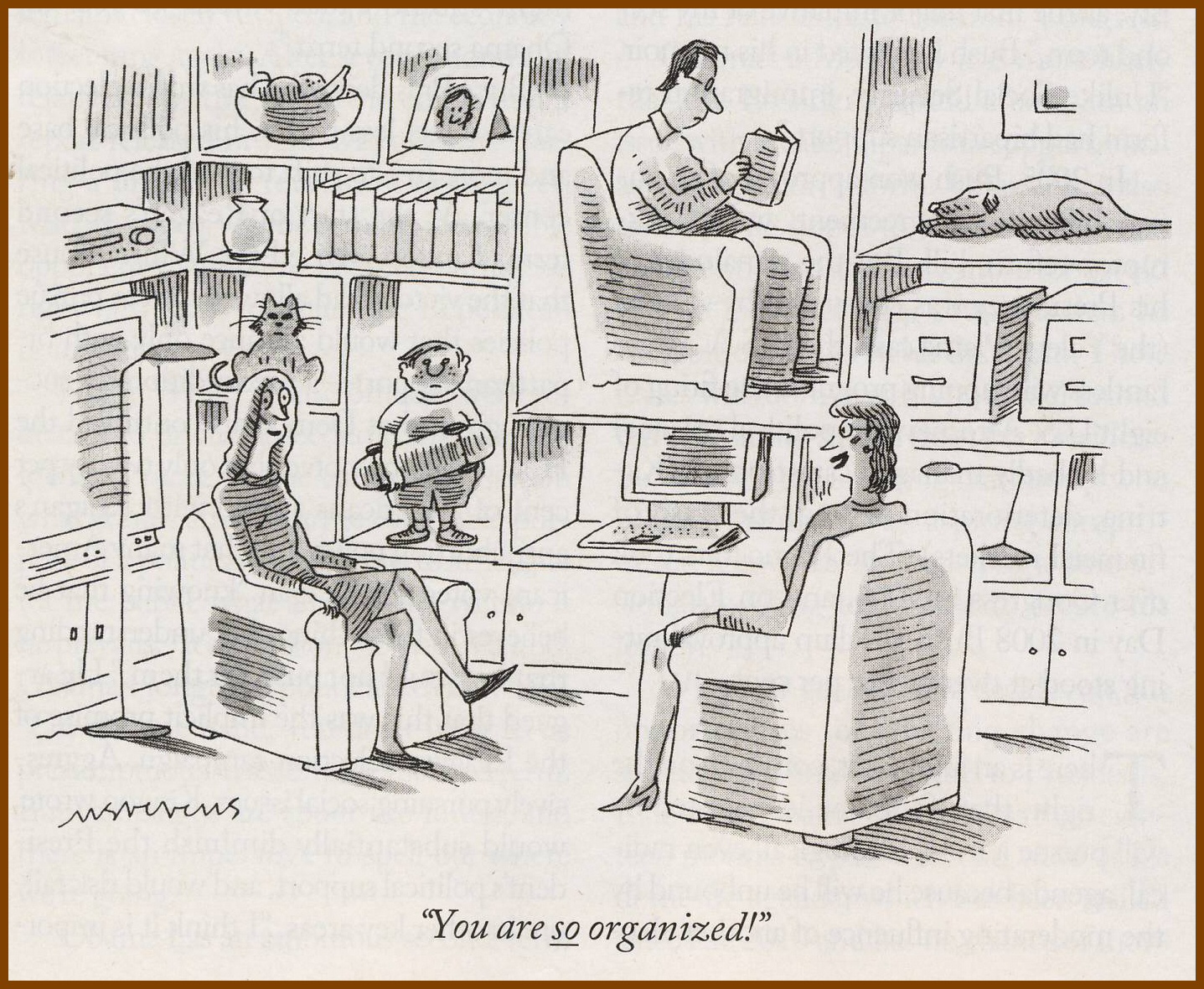
What do you think, maybe not so much organized as compartmentalized?

The Limits of Anxiety

Sure, everyone feels anxious at one time or another. There are situations and people and behaviors we’re quite right to feel uneasy or apprehensive about for all kinds of reasons. But the three Thinking center types know and live with anxiety on a different, more fundamental, level since anxiety (fear without a focal point) is their primary issue. Types 5, 6, and 7 each have a different focus for their anxiety (they fear different things) and deal with it differently, but all of them live with it to one extent or another.

Fear is a reaction to a perceived threat. It signals us that we’re in danger so we can react to the threat and save ourselves. If we succeed in saving ourselves, we’re no longer afraid because the threat is over. Anxiety, on the other hand, is a chronic state of worry. There’s no specific action we can take to resolve it because there’s no clearly identifiable threat. It’s kind of an anti-survival mechanism because over the long haul it can have deadly consequences. Continue reading