Tag Archives: Enneagram

The Type 3 Culture of est (Part 1)

In which the universe hoodwinks me into being trained by Werner Erhard himself.

English: Face portion of a casual photo at a m...

Werner Erhard. (Photo credit: Wikipedia)

I took est (officially Erhard Seminars Training, but known to us graduates simply as “the training”) in the early 80s. I’m surprised I didn’t encounter it much earlier, since I moved to San Francisco in 1974 in an experimental frame of mind and San Francisco was home base for est. I bumped into the Scientology crew downtown one night and signed up for their beginners’ class just to find out what it was all about. I enjoyed the class, but that organization had so many layers of bureaucracy, it made the IRS look streamlined. I also spent some time at one of the Synanon enclaves in the East Bay, since the first friend I made in the City was an ex-junkie. (Synanon was an alternative drug rehab community founded by Chuck Dederich, a former alcoholic.) But I don’t recall ever running into anyone around that time who was involved in est.

A friend in Michigan had taken the training, however, and would not shut up about how amazing it was and how I should take it, too. I was tired of hearing about it, so on one of my visits, I agreed to go with him to a guest seminar if he agreed that regardless of whether I decided to take the training or not he would stop talking to me about it. We had a two-hour drive to Detroit where the seminar was being held. On the way, I had to listen to a series of cassette tapes of talks given by Werner Erhard. I hated the sound of Werner’s voice so much that my mind was made up: there was no way I was going to take the training.

As it turned out, the man who led the guest seminar (Les?) had a very low key and matter-of-fact demeanor. He was the anti-Werner Erhard, if you will. What he said made sense and sounded like something I could benefit from. Est was supposed to “transform one’s ability to experience living so that the situations one had been trying to change or had been putting up with clear up just in the process of life itself.” Sign me up. But wait a sec. It turned out that although Werner had not been involved in leading trainings for a while, rumor had it he was going to lead the next scheduled training in San Francisco. So no, do not sign me up for that one. What else do you have? The next available training in my neck of the woods was in the East Bay.

WHAT WAS I THINKING?

So, yes, I enrolled in a training in Berkeley, which involved a considerably longer commute, just so I could avoid Werner Erhard—the founder of the training I was enrolling in. Absurd as they were, my efforts turned out to be for naught.

The est training consisted of two weekends (all day Saturday and all day Sunday) and three Wednesday evening sessions in between the two weekends. The Wednesday evening before the first training weekend, my partner and I, along with a couple hundred other trainees, trooped into the ballroom where the training would be held. I glanced at the staff in the back of the room, and although I had never seen a picture of the man, I said to my partner—and these were my exact words— “Fuck. That’s Werner.” Which it was.

I got over my resistance to Werner. The man is very charming and disarming, as well as relentless. He’s generally typed as a 3, which seems right on. Although I hated the training itself, that didn’t have anything to do with Werner (other than the fact that he created it). What I didn’t like was having to sit in a chair hour after hour listening to other people talk. You could say I resisted that. And I resisted being confronted with my own stuff, which you’re pretty much forced to confront while you’re sitting in a chair hour after hour unable to escape or even converse with the person seated next to you.

It’s true that you were not allowed to go to the restroom except during the very infrequent official breaks. On the first day of the training, I got into a conversation with someone during the first break and failed to make use of the restroom before we were ushered back into the training room. Five hours till the next opportunity. Herb Caen, who was a long-time columnist for the San Francisco Chronicle, once included an anecdote about a woman who asked a clerk in a downtown San Francisco department store to direct her to the ladies room. The clerk said there were no restrooms on the premises. The customer asked what the clerk did when she needed to use the restroom. The clerk said, “I took est. I don’t have to use the restroom.” My friends today will tell you that I can go longer than anyone else they know without needing to stop for a bathroom break. That has been so valuable I think it was worth the price of the training.

But that’s not all I got.

Next time: Part 2, in which I am apparently recognized as an 8, even though none of us has heard of the Enneagram yet.

Type 6 Friend

Last in the series of type comics. The rest can be found here: Type 1, Type 2, Type 3, Type 4, Type 5, Type 7, Type 8, Type 9.

Type 6 Friend

Typing Abraham Lincoln

English: Abraham Lincoln, the sixteenth Presid...

Abraham Lincoln, the sixteenth President of the United States. (Photo credit: Wikipedia)

Abe Lincoln is all the rage these days, and I’ve been going with the flow. I recently finished reading Rise to Greatness: Abraham Lincoln and America’s Most Perilous Year. This extremely well-researched and well-written book by David Von Drehle covers the year 1862, Lincoln’s first full year in the office of President. On the first day of 1863, he signed the Emancipation Proclamation.

Shortly after finishing the book, I saw the movie, Lincoln, which takes place in 1865, the year the 13th Amendment was passed by the House of Representatives.

Just about everyone in the Enneagram world seems convinced that Abraham Lincoln was a 9w1. Typing famous people, dead or alive, is common among Enneagram experts and amateurs alike. It serves a purpose in offering examples of types. But it runs counter to most teachers’ recommendations that people come to their own conclusion about which type they are. Many of the people who are held up as examples of type never heard of the Enneagram, let alone filled out a questionnaire or tried to identify themselves. And we can’t get inside their heads to understand where they were coming from or what motivated them. In a lot of cases, all we see is what’s on the outside. So we should take all of this typing of dead people with a grain of salt—or at least a caveat or two.

As far as Abe Lincoln goes, I will agree from what I’ve read that he was most likely a 9. Had he not had such a grasp of the big picture—keeping the Union together—our world would be inconceivably different today. But I’m not sure why everyone believes he had a 1 wing. Is it because of his nickname, “Honest Abe”? Or is it because only someone with a 1 wing (an Idealist) could possibly have been responsible for the Emancipation Proclamation and for bringing an end to slavery? If so, that’s the kind of stereotyping that should make us Enneagram experts squirm.

More 8 than 1

Lincoln was an ambitious man who wanted to make his mark, to have an impact on his world, to be remembered. He was also notoriously thick-skinned. Those are not signs of either 9s or 1s. Those are characteristics of 8s. 8s, too, are greatly concerned with justice, fairness, and equality and with defending and protecting the underdog, whoever they perceive the underdog to be. When 8s take up causes they will do whatever they feel is necessary to achieve their goals. If that includes making under-the-table deals with the “enemy”—as Lincoln did in order to get the votes he needed for the 13th Amendment—so be it. If that includes shading the truth—as he did about the existence of peace talks with the Confederacy in order to assure the House vote took place before the war ended—so be it. The ends very often justify the means for 8s.

As I was reading Von Drehle’s book, I came across many descriptions of Lincoln’s behavior, attitudes, and personal characteristics like these:

  • He had always been proud of his physique, and enjoyed challenging other men to contests of strength, which he inevitably won. He used his size subtly to intimidate, even as he used his humor to put people off guard.
  • …[F]or now Lincoln was still the virile figure of his campaign propaganda, the rail-splitter whose blend of brains and brawn reflected America’s favored image of itself: strong, bright, and independent.
  • Lincoln had a shambling animal force about him, which some found appealing and others found unsettling.

Which type does that remind you of?

When I brought up this typing issue with a friend who is a 1w9—and a history buff—he said he had never thought of Lincoln as an idealist. After seeing Lincoln, I suggested to him that Thaddeus Stevens might have been a 1. At least as portrayed in the movie, he was greatly pained when he reluctantly agreed to deny what he believed to be moral and true in order to achieve the short-term gain of passage of the 13th Amendment. Lincoln, on the other hand, did not seem to have those sorts of compunctions about the wheeling and dealing he undertook for what he saw as the greater good.

Lincoln was a politician. He never denied that. I think being a 9w8 made it possible for him to see what needed to be done in the broadest of terms and then to be able to do it, no matter how he had to bend either rules or people.

From time to time, even “Honest Abe” himself exaggerated or dissembled in pursuit of a great cause.

— Lincoln scholar Harold Holzer

I highly recommend both the book and the movie and plan to write about General George McClellan, who fairly jumps from the pages of Von Drehle’s book as a perfect example of a 5. Of course, McClellan is dead and I never met the man, but strictly as portrayed in Von Drehle’s book–my caveat–he’s a classic type 5.

Type 9: Embrace Your Inner Troublemaker

English: Yin & Yang

Yin & Yang (Photo credit: Wikipedia)

When tempers flare, when sides cannot agree, when petty disagreements threaten to tear people or projects apart, you need someone to broker a peaceful resolution. You need a 9, right? 9s are not going to get caught up in the battle. They are going to focus on the bigger picture—on what is best for everyone. That’s why they’re called Peacemakers. They’ll see all sides and find a way to bring people together.

Maybe. On the other hand, they could as easily tune out the conflict and go about their business pretending nothing is happening. Or play the role of sacrificial lamb in order to appease everyone else (which no one ever fully appreciates, much to the annoyance of 9s). Or withdraw into passivity—or even become passive-aggressive.

But 9s really do want to know why we can’t all just get along. The fact that we don’t—and that getting along isn’t even a top priority for some of us—pains them a great deal. They place a high value on peace and understanding, which is why they make excellent mediators, counselors, listeners, and healers.

9s go to great lengths to maintain an attitude and an appearance of calmness. But what lies beneath that exterior of peace, serenity, and agreeableness? Their occasional passive-aggressive responses hint at the hostility that burns down below. Hostility is anathema to 9s, so they may try to deny they’re feeling it, or at least attempt to keep it from leaking out into the atmosphere where others can get wind of it. But feeling angry, out of sorts, or disagreeable once in a while is normal. Trying to repress those “negative” feelings takes a lot of energy, which may be one of the reasons naps are so appealing to 9s.

Thank you, Donna, for sharing this.

Thank you, Donna, for sharing this.

TAKE OFF THOSE GLOVES

When 9s embrace their Inner Troublemaker, they can drop the other shoe that everyone has been waiting for them to drop. When they see that the world hasn’t stopped spinning, and they haven’t been ostracized from the tribe of humanity, they can finally exhale. They’re still standing. Still breathing. Maybe they don’t have to continue the futile pursuit of smoothing everyone’s ruffled feathers and trying to shield themselves and their loved ones from conflict. Feathers get ruffled. Conflicts break out. Such is life.

9s may discover that accepting and expressing their own hostility is quite freeing. First off, it frees up their own energy. (9s with an 8 or a 1 wing probably already have some experience of this.) It also frees the people around them to be a bit more authentic—and there could be some pleasant surprises there for 9s.

A mind that is always on guard against conflict and disharmony—whether internal or external—is bound to be an anxious mind. Harmony/disharmony is just like up/down, dark/light, happy/sad, yin/yang; you can’t have one without the other. Try as you might. So you might as well stop trying.

Curiouser and Curiouser

Naima, the Curious Cat

Naima, the Curious Cat

In his book, Waking Up, Charles Tart points out that most people, especially in the West, aren’t taught self-observation skills at an early age. What if we had spent as much time learning how to observe ourselves as we spent learning how to read?

I’m a fanatical reader, so I don’t say this lightly, but maybe self-observation skills are even more valuable than reading skills. In many ways, reading helps open up the outer world to us, but self-observation opens up our own inner world—which is no less vast, really.

These are a few things Tart has to say about self-observation.

It’s all grist for the mill

In its most general form, the practice of self-observation is simply a matter of paying attention to everything, noticing whatever happens, being open-mindedly curious about all that is going on. This everything will almost always be a mixture of perceptions of external events and your internal reactions to them. You should drop all a priori beliefs about what you should be interested in, what is important and not important. Whatever is is an appropriate focus for observation.

THREE WAYS TO PAY ATTENTION

This open-minded attention must be more than just intellectual attention. Remember that we are three-brained beings. Thus the attention we should strive to pay to our world and our selves is an emotional attention and a body attention as well as an intellectual attention.

Above all, be curious

The practice of self-observation…is the practice of being curious, along with a commitment to do your best to observe and learn whatever is there, regardless of your preferences or fears.

I have to keep reminding myself to stay curious about what is going on around me and within me. And also to stay curious about my own actions and reactions. It’s so much harder for me to get sucked into the drama, the compulsions, and the autopilot behavior when I’m able to maintain an attitude of curiosity about everything that’s happening.

My usual modus operandi is probably the same as everyone else’s. I operate on the assumption that there’s a way things should be and when things are going the way they should be going, all’s well. But more often than not, things do not go the way I think they should. And people do not behave the way I think they should. Even I don’t behave the way I think I should. And don’t get me started on the weather!

As an 8, when things are not going as I expect them to go, my resistance kicks in. That’s a perfect opportunity to wake up and pay attention. When I’m able to do that, I feel much lighter and more expansive. When I don’t or can’t do it, I dig myself deeper into my resistance. No good ever comes of that.

What kicks in for you when things aren’t going your way?

If I want to use the moments when my expectations rub up against the edge of reality to wake up, I have to have the intention to do so.

The practice of self-observation begins with a desire and resolution on your part: “I want to know what really is, regardless of how I prefer things to be.”

As I’ve remarked elsewhere, self-observation is not for wimps. It isn’t easy to let go of our preconceived ideas about how the world should work. It’s hard to give up having a temper tantrum when we don’t get our way. Growing up can be painful at times.

If you diligently practice self-observation, you will see much that his painful and much that is joyful, but seeing more of reality will turn out to be highly preferable to living in fantasy. You will begin creating “something” in yourself, a quality, a function, a skill, akin to learning how the controls of your automated airliner work. And you will be pleasantly surprised at how much more there is to life.

Meditation: Move, Sit, Chant

Breathe

Breathe (Photo credit: PhotoLab XL)

Unless we have the capacity to be still and listen, we can’t tune in to our own inner guidance, in which case we’re more or less doomed to remain stuck in the vicious cycle of our thoughts, feelings, and actions. Acting out the same compulsions. Repeating the same stories about ourselves over and over again.

Meditating is a great way to learn to be still and to develop self-observation skills.

Meditation expands the space between each thing you notice and each action you take.

Ram Dass

There are many different ways to meditate. The best way to begin is by finding a method that isn’t overly difficult. Expecting to be able to sit or kneel in meditation and immediately clear your mind is unrealistic—and it isn’t even the point of meditation. You can’t stop the stream of thoughts, feelings, and physical sensations that come and go. But you can learn to observe how they arise and fall away. You can stop getting hooked by them. Or, as Jon Kabat-Zinn puts it, “You can’t stop the waves, but you can learn to surf.”

Meditation Sticker

Meditation Sticker (Photo credit: Sanne Schijn)

One approach to finding a way to meditate that works for you is to look to the Center of Intelligence that is your Home center: Doing, Thinking, or Feeling.

Doing center types may find one of these active practices more appealing:

  • Aikido
  • T’ai chi
  • Walking
  • Kung Fu
  • Hatha Yoga

Thinking center types may prefer some type of insight meditation:

  • Vipassana
  • Mindfulness
  • Visualization
  • Contemplation
  • One-pointedness of mind

Feeling center types may appreciate a practice that includes an emotional aspect:

  • Sufi dancing
  • Singing
  • Chanting
  • Prayer

This is just meant to suggest a starting point. In addition to helping develop self-observation skills, meditation has many health benefits, so no matter how you go about it, meditating is a good habit to cultivate.

Something for Everyone

Here are two meditation practices anyone can do:

  • Choose a mantra (a word or phrase that has meaning for you) and repeat it over and over while you are working driving, talking, etc. Say it out loud if you like—and are alone—or repeat it silently.
  • Focus on following your breath in and out, in and out. If you lose track, just refocus on your breathing.

You can do either of these practices no matter where you are. They can help you stay grounded, centered, and present instead of carried away by whatever is going on in the moment.

Meditation…A Thoughtless Act

And here is a tongue-in-cheek piece from the October 1999 issue of Enneagram Monthly on tips to improve each type’s meditation. The author is anonymous.

  1. Close your eyes. Go inside. Take a breath. Take a better breath than that.
  2. Close your eyes. Go inside. Take a breath. Help your neighbor take a breath.
  3. Close your eyes. Straighten your hair. Adjust your collar. Smooth the creases in your dress.
  4. Close your eyes. Go inside. Take a sigh.
  5. Close your eyes. Go inside. Stay inside.
  6. Close your eyes. It’s OK; close your eyes. Close both eyes.
  7. Close your eyes. Go inside. Imagine you are at the beach. Now in the mountains. Now in the desert. Now at a party.
  8. Close your eyes. Go inside. Take a goddamn breath!
  9. Close your eyes. Go inside. Take a breath. Take your neighbor’s breath.

It’s best to approach meditation lightly, rather than with dogged determination.

Type 8: Embrace Your Inner Weak Sister

Powerful, I take responsibility for who I am, ...

(Photo credit: Tomas Sobek)

8s are pretty darn capable people. They will do whatever it takes to get the job done. Sometimes they will even do more than it takes. They are proud of being able to accomplish what they set out to do and of their ability to deal with adversity, challenges, and obstacles. 8s tend to feel as if they can weather whatever storm nature throws at them. If you are being treated unfairly—caught in a metaphorical or an actual storm—8s will also direct their considerable energy on your behalf.

But their tough exterior covers the same kind of fear every other type has, which is that deep down—or when push comes to shove—they are not all that. 8s whose identities are completely wrapped up in being a powerful force of nature expend quite a lot of energy proving it over and over again to themselves and to everyone else. Once is definitely not enough.

However, no man is an island—and no woman is, either. We are interdependent. We need each other. As far as 8s are concerned, it’s perfectly OK for someone else to be needy. But it’s definitely not OK for 8s to feel needy, actually be needy, or—horrors!—be seen as needy. It’s kind of the opposite situation to the boy who cried wolf. 8s do such a good job convincing everyone else of their hardiness and durability that others assume they don’t need help. Ever.

Notice that 8 over there who just fell through the ice? No worries. He’s got everything under control. See, he’s signaling that he’s just fine. Yes, he’ll be waving everyone off until the moment he slips under the ice and is gone, victim to his compulsion to always be the rescuer and never the one who is rescued.

It’s great to be able to tough things out, but it’s not so great to risk life and limb out of the compulsion to tough them out.

People…people Who Need People…*

One of the things 8s fail to recognize, in addition to the utter folly of their total commitment to their position, is that other people like to be needed. They appreciate being able to help each other. Another thing is that always being the one to lend a hand and never being willing to accept a hand creates an imbalance in all of one’s personal relationships. This ought to make an impact on 8s, who are greatly concerned with fairness and balance. Give and take—or give and accept—would make a good mantra for 8s.

When 8s embrace their inner Weak Sister (whether male or female), they can let down their guard and admit they don’t have every single thing under control. They may not be able to deal with a thing or two life throws at them. So once in a while, they could possibly use a little help from their friends. It’s OK to ask. When they do, they may be surprised to find out that expressing vulnerability does not knock them down a notch in everyone else’s eyes. It might even raise them up a notch or two.

*not an endorsement of the song

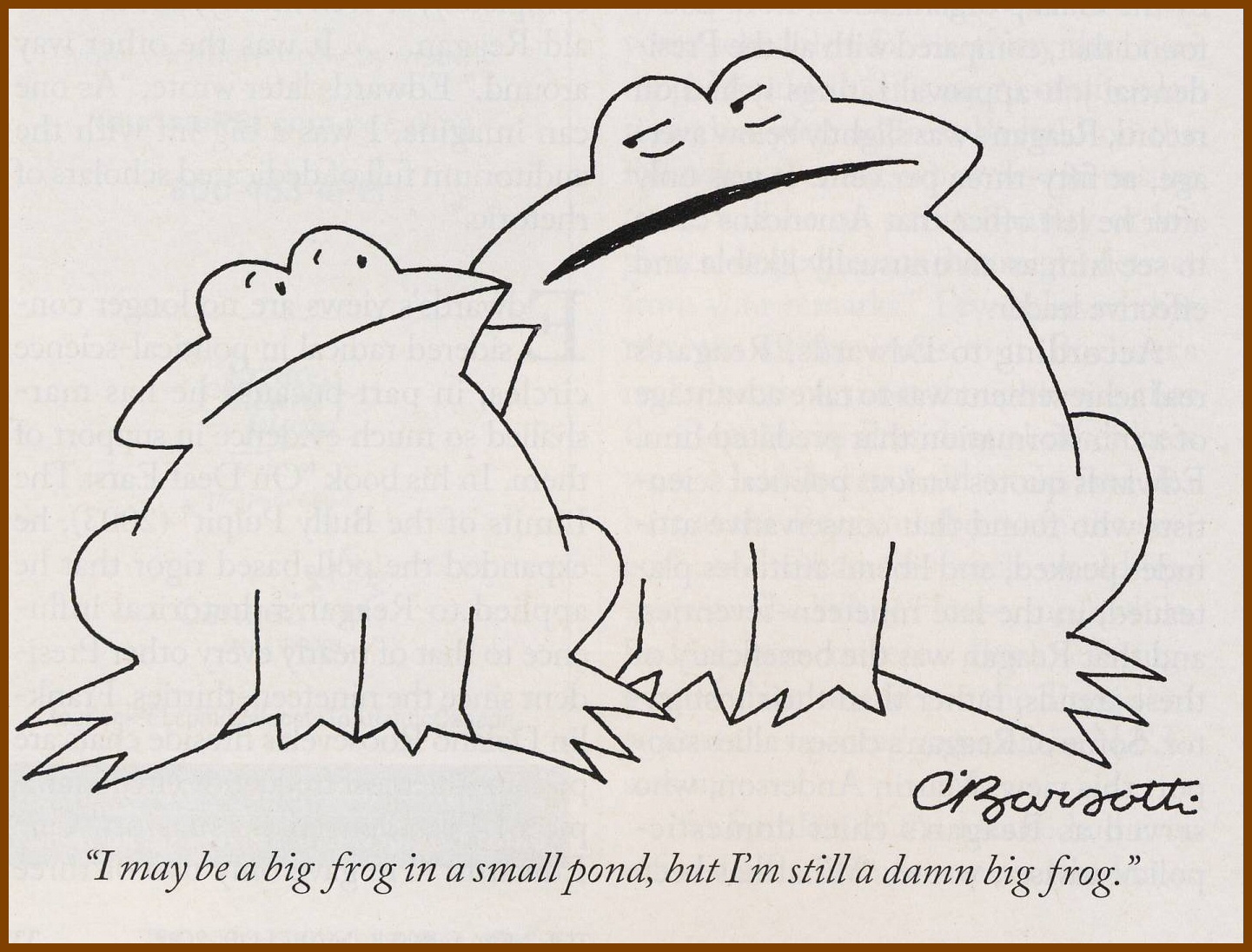
Type 3 Frog

Eighth in the series of type comics. The others can be found here: Type 1, Type 2, Type 4, Type 5, Type 7, Type 8, and Type 9.

The Image in the Mirror

Raistlin Majere. Image by Vera Gentinetta. Tic...

Image by Vera Gentinetta. (Photo credit: Wikipedia)

A self-image is a lot like a work of fiction in that it is heavily edited before being presented to an audience. It is seen first by an audience of one—oneself—and then the public audience of friends, family, co-workers, and even strangers.

One of the ways we maintain a consistent self-image is by repeatedly telling ourselves stories that reinforce it. Another way we do it is by repeatedly telling other people stories about ourselves that reinforce it. We are, as Jonathan Gottschall puts it, storytelling animals. It’s our nature to pull together our experiences and perceptions into a coherent linear narrative. That’s how we make sense of the world. And that’s how we create the fictional characters we claim to be.

It isn’t as if we’re intending to lie about who we are. It’s that we are invested in being—and being seen—in a particular light. So we edit out the parts of our lives, past and present, that don’t fit the role we’re playing.

While it’s true that image is the primary issue of the three Feeling Center types, they aren’t the only people who construct and nurture their own self-image and the image they present to the world. We all do it.

What’s Your Self-Schema?

A lot of our efforts to maintain a consistent self-image are habitual and automatic, so we aren’t even aware of them. In the process of developing generalizations about ourselves, we form cognitive structures called self-schemas. These self-schemas then organize and guide the processing of information that is self-related. That means they determine what we pay attention to and how events and experiences are encoded in our memories. Self-schemas are biased on their own behalf. If something fits our self-schema, for example, we are likely to pay more attention to it and to remember it more easily. We tend to dismiss what doesn’t fit our self-schemas.

We don’t have just one self-schema; we have several, depending on the different roles we play in life. But there are some aspects of our self-schema that are consistent across all of them. If you know your Enneagram type, you know what many of those are for you.

Self-schemas are self-perpetuating and very difficult to change. You have to be open and willing to explore the possibility that you are not your self-image. Your self-image is a fictional character you have been developing—usually with some help from the people closest to you—for most of your life.

Wei Ji, the Chinese symbol for crisis

When something happens that significantly messes with our self-image, the result can be denial or a crisis of identity. But while such an experience can present a danger to our self-schema, it is also an opportunity to step out of character and address the audience directly (authentically).

Is that Really True?

There are a couple of simple steps you can take to become more aware of how you are perpetuating your self-image.

  • When you catch yourself telling stories, whether to yourself or someone else, you can stop and ask yourself if they are really true–or if they represent the “whole” story.
  • You can make a list of things you believe about yourself, and then for each one, ask yourself if it is really true. Be ruthless.

Trying to uncover the truth of who we are can be like chasing a moving target, difficult to hone in on. But it’s a liberating experience that’s well worth the effort. The reward is that we get to break free of the confines of the structure that has defined us and dictated what is possible for us.

Each one of us has many more dimensions than the scripted characters we have been playing.

Type 7: Embrace your Inner Sad Sack

Saturday Night Dance Party

Saturday Night Dance Party (Photo credit: dpstyles™)

To the consternation of many 7s, life isn’t always a party. The great thing about parties is that there’s always so much stimulation–music to listen and dance to, people to talk with, food and maybe alcohol to consume, sometimes games to play—that 7s can give themselves over to sensation and lose themselves, which is exactly what they want to do.

7s run as fast as they can from experience to experience in the external world—and always with a grin or a smile in place—in order to avoid being dragged down by their interior world. They are working extremely hard to convince themselves and everyone else that what you see is what you get, that their hail fellow well met persona is who they truly are. But, of course, they know better. What they’re afraid to acknowledge and are so busy trying to fill up is a sense of emptiness. Not emptiness in the Zen sense of peace and spaciousness. Emptiness in the sense of a lack of meaning or substance.

This isn’t to say that 7s are empty inside or that their lives lack meaning. But a meaningful life includes acknowledging painful truths, unpleasant experiences, and uncomfortable emotions, all of which is anathema to 7s. The problem is that by running from these experiences, 7s create a vicious cycle in which they actually exacerbate the problem. It isn’t possible to try enough new things, to consume enough food, alcohol, or drugs, or to accumulate enough material possessions to avoid the void forever. And attempting to outrun it is a very dangerous game.

Party of One, please

7s need to get off the carousel, find a quiet spot, and embrace their inner Sad Sack. They need to stop trying to distract themselves and acknowledge their own sadness, anger, grief, anxiety, and fear. When they do, they may be surprised to discover that, although these feelings are not pleasant, they are not lethal. Everyone experiences them to some degree or another. Shared emotions—whether happy or sad—are something all humans have in common.

When 7s recognize this and own up to the feelings they have been running from, they won’t deflate like a burst balloon. They will expand their options and their ability to empathize with and relate to other people. They will be able to slow down and choose what to focus their attention and their nimble minds on and have a better chance of actually completing what they start.

There’s freedom and strength in facing what we’re most afraid of. And for 7s there’s also the bonus of discovering that what they’ve been frantically searching for all this time is something they already have inside themselves.